Book One · Isaiah Chronicles

Discovery Cards

Every card is a verifiable fact from the world of the novel. Artifacts in museums. Characters in scripture. Threads that run through the whole series.

What are the Isaiah Chronicles Discovery Cards?

The Discovery Cards are 40+ free reference cards covering the artifacts, characters, quotes, and timeline of The Isaiah Chronicles. Each card pairs a verifiable fact — a real museum object, a cited scripture, or a historical event — with the corresponding passage in the Book of Isaiah or the Book of Mormon. Click on each card to see the back descriptions in more detail! The artifact cards cover the Hezekiah Bulla, Siloam Inscription, Sennacherib Prism, and Lachish Reliefs — 8 verified artifacts across 4 countries. The character cards cover Isaiah, his wife Hodijah, King Ahaz, King Hezekiah, and Manasseh. The quote cards carry verbatim scripture from Isaiah, 2 Nephi, and 3 Nephi. Isaiah is quoted approximately 60 times directly in the New Testament and accounts for 21 of 66 chapters quoted in the Book of Mormon. The cards are free in English; Spanish, Portuguese, French, and Filipino editions are in production.
What does John 12:41 say about Isaiah?

The Apostle John identifies the figure on the throne in Isaiah 6 — the one whose glory filled the temple — as the premortal Jesus Christ. This is the foundation of the Isaiah Chronicles Face on the Throne card: the vision Isaiah saw was not merely a vision of God in the abstract, but of the specific person who would become the mortal Jesus.

"These things said Esaias, when he saw his glory, and spake of him."

Published · Updated

⭐ Start Here
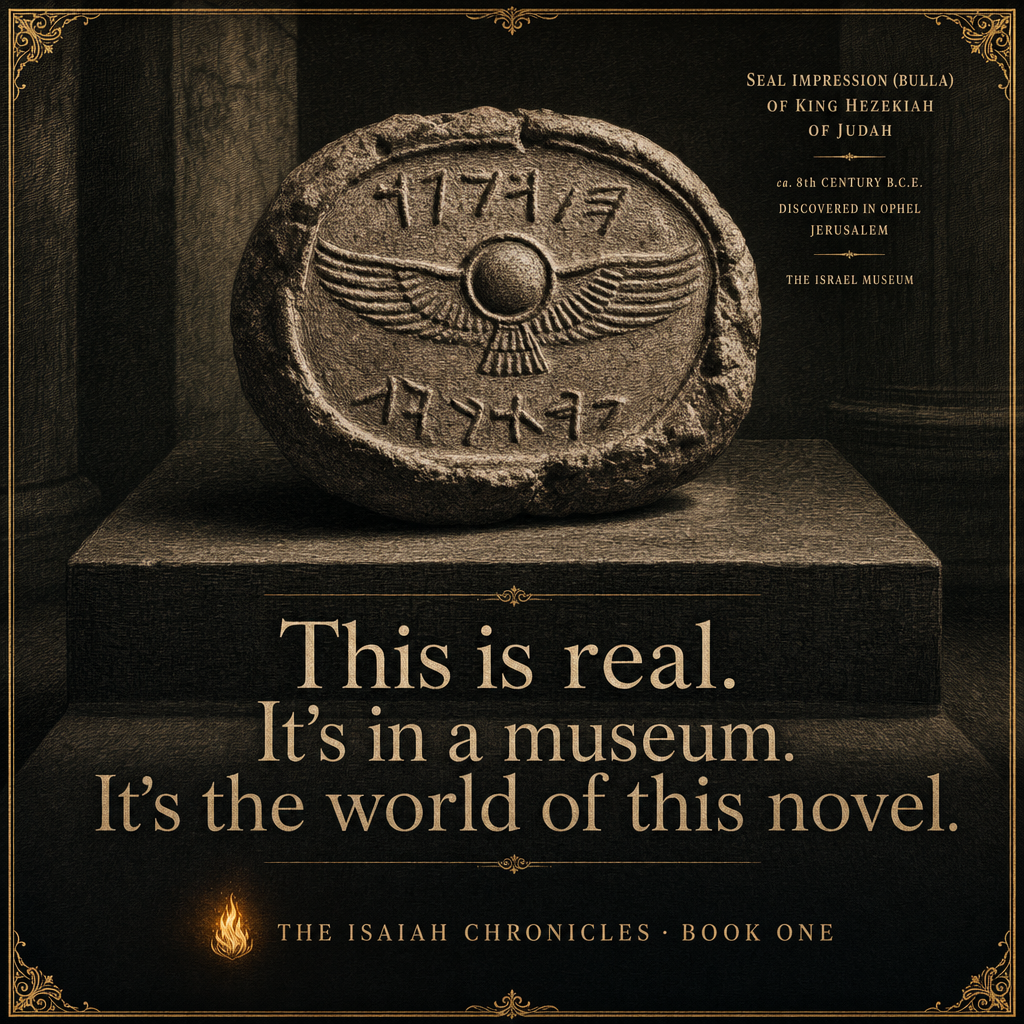
The Hezekiah Bulla
B1-01MAIN

This is real. It's in a museum. It's the world of this novel.

The seal impression (bulla) of King Hezekiah of Judah — the king Isaiah served — was excavated in the Ophel, Jerusalem. It bears a winged sun-disk and the Hebrew inscription "Belonging to Hezekiah, [son of] Ahaz, king of Judah." The man Isaiah whispered to left a fingerprint in the dirt.

📜 Isaiah 36–37

Read Book 1. The king whose seal this is appears in the story.

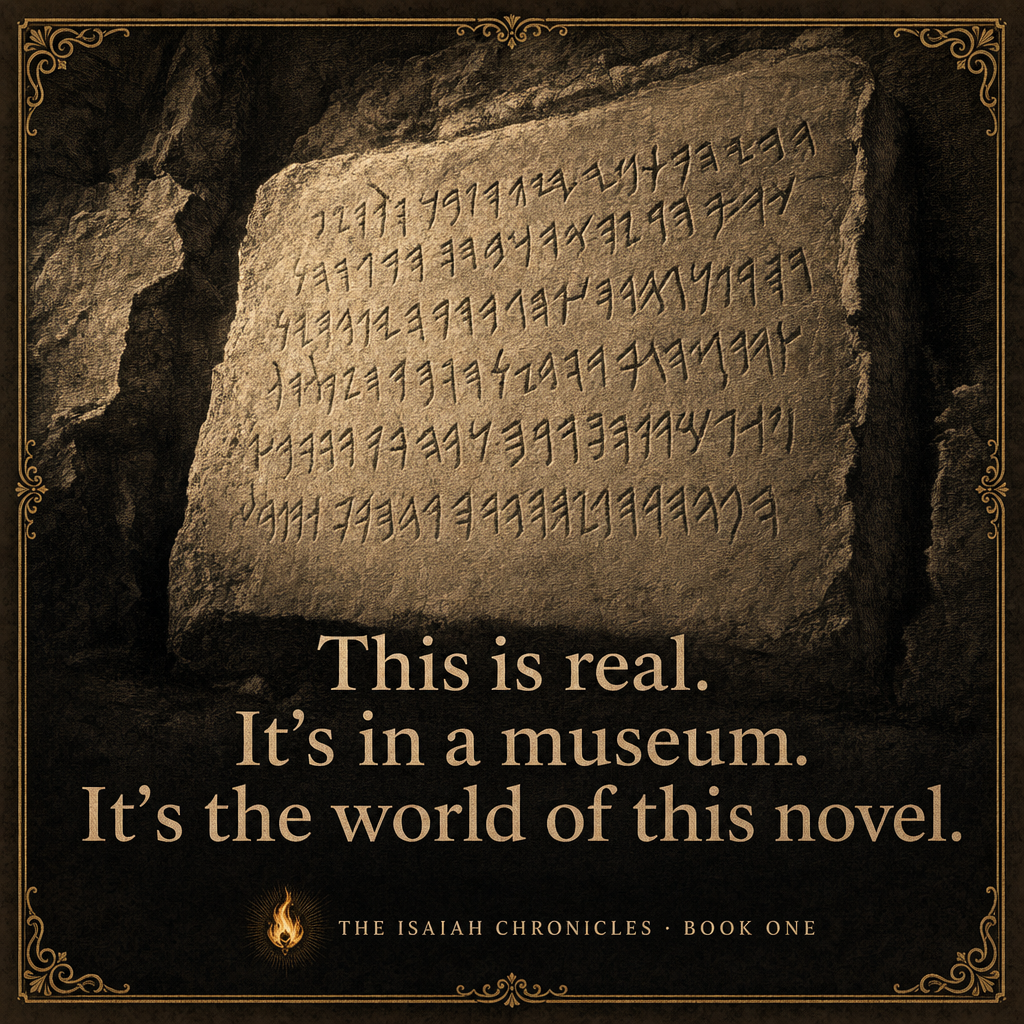
The Siloam Inscription
B1-02FORWARD

This is real. It's in a museum. It's the world of this novel.

The Siloam Inscription records the moment two teams of tunnelers, digging from opposite ends, broke through to meet under Jerusalem — Hezekiah's tunnel, built to secure the city's water supply before the Assyrian siege. The workers could hear each other's picks through the rock.

📜 2 Kings 20:20

Read Book 1. The tunnel is in the story.

The LMLK Seal
B1-06SIDEWISE

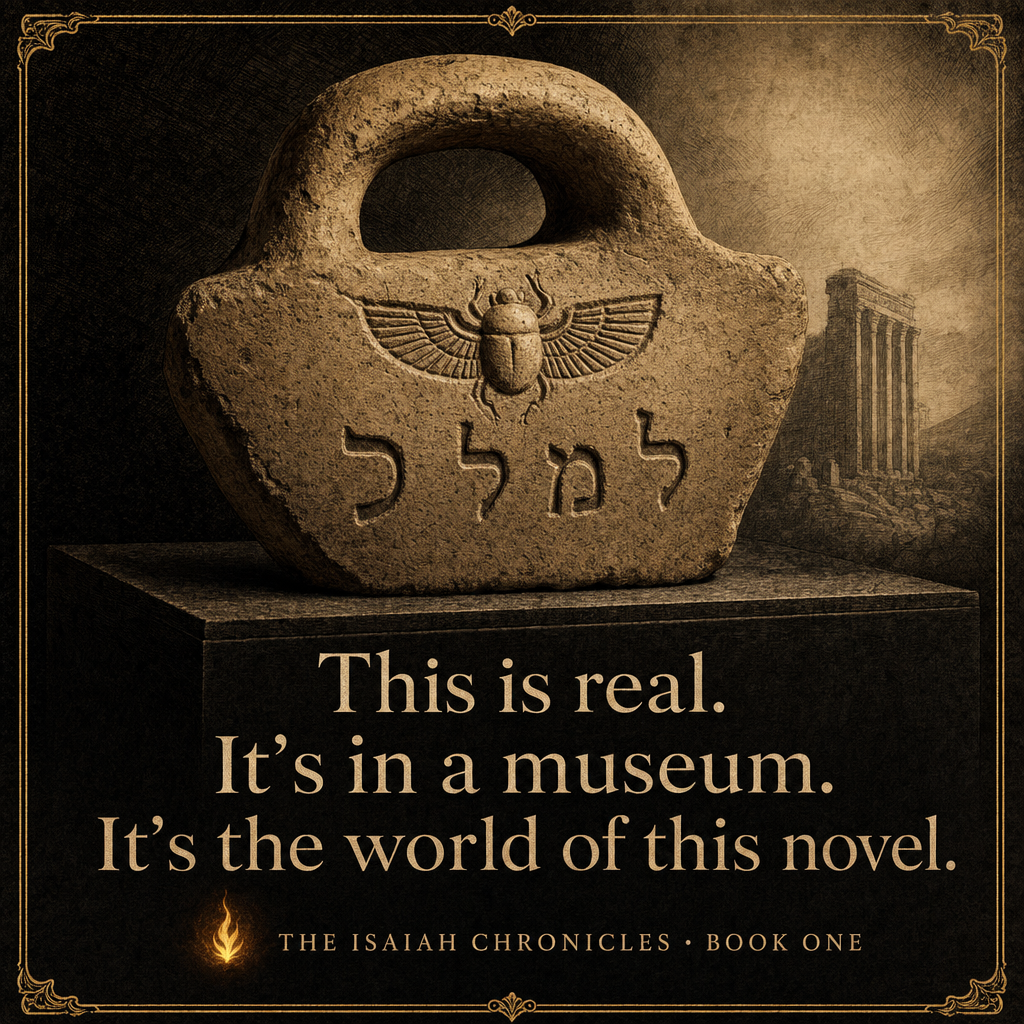
This is real. It's in a museum. It's the world of this novel.

Hundreds of LMLK ("belonging to the king") jar handles have been found across Judah — stamped with a winged scarab or sun-disk, used to mark royal provisions. They are the fingerprints of Hezekiah's war preparation. Isaiah watched the jars being filled.

📜 2 Chronicles 32:27–29

Read Book 1. The storehouses are in the story.

Shear-Jashub & Maher-Shalal-Hash-Baz
B1-09MAIN

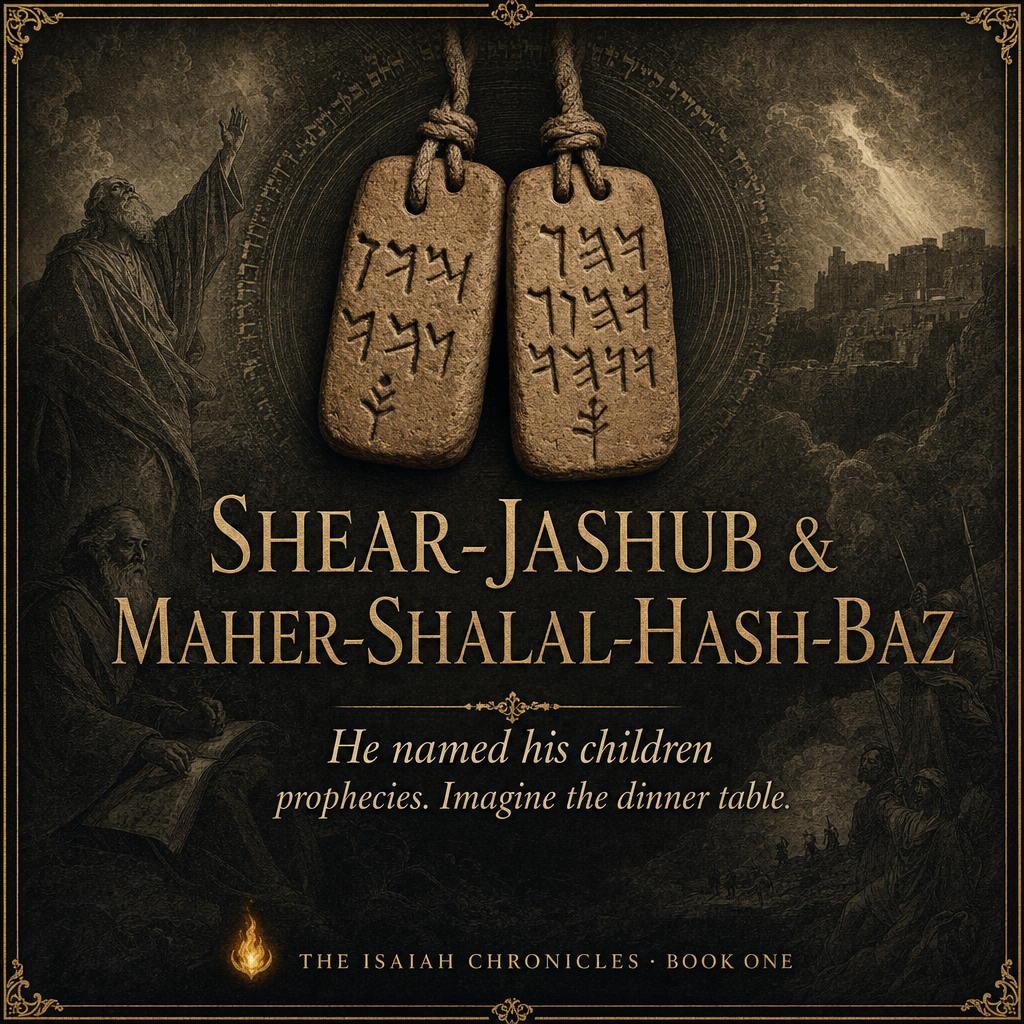
Isaiah's sons weren't just named — they were deployed.

Isaiah named his first son Shear-Jashub ("a remnant shall return") and his second Maher-Shalal-Hash-Baz ("swift is the booty, speedy is the prey") — the longest personal name in the Bible. God told him to take Shear-Jashub with him to meet the king. The boy's name was the message.

📜 Isaiah 7:3 + Isaiah 8:1–4

Read Book 1. The boys are in the story.

Advance your Discovery Guide to unlock this card.

B1-10 · Sealed
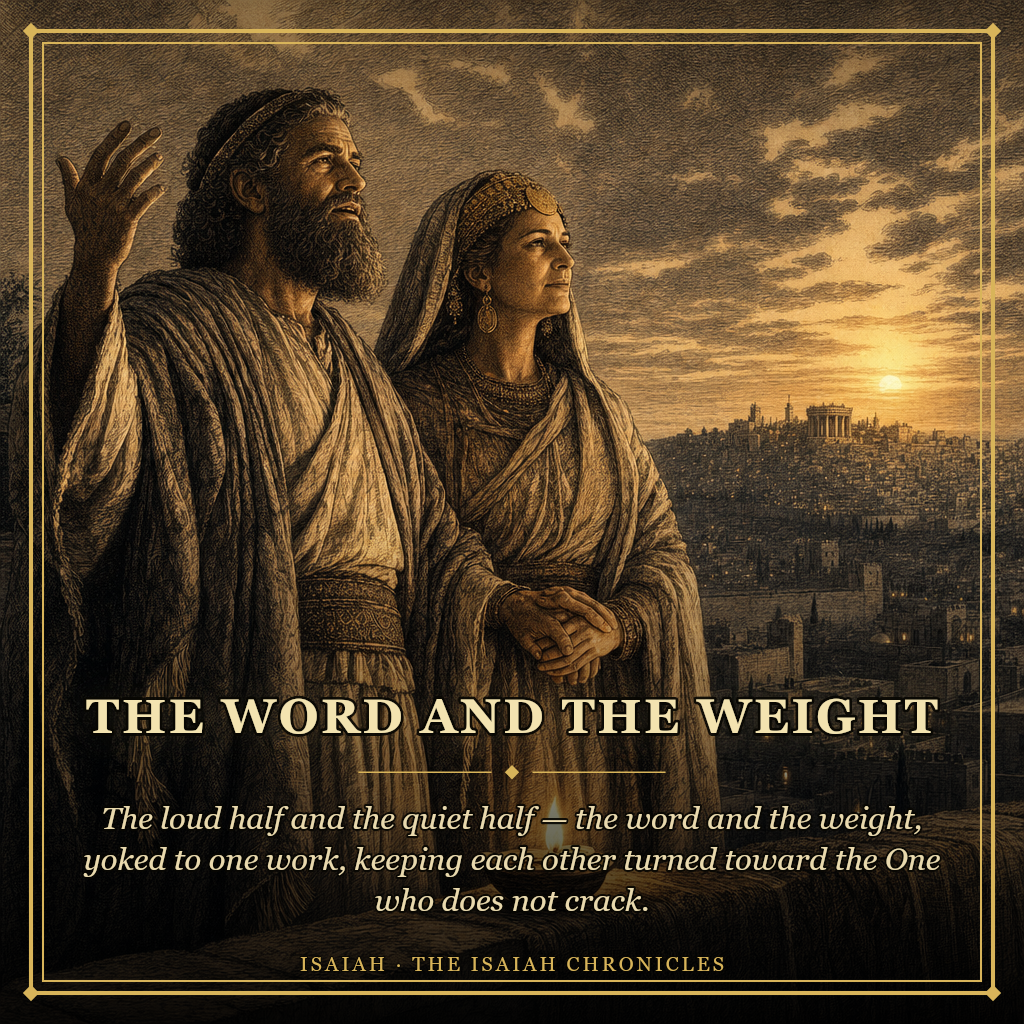
The Word and the Weight
H-01MAIN

He carries the word. She carries him.

Isaiah 8:3 names her only as "the prophetess" — but she is the one who bears the sign-children, who keeps the household when the prophet is summoned to the palace, and who holds the weight of a calling that was never only his. The word came to Isaiah. The word cost Hodijah.

📜 Isaiah 8:3

Read Book 1. The word and the weight begin on the same page.

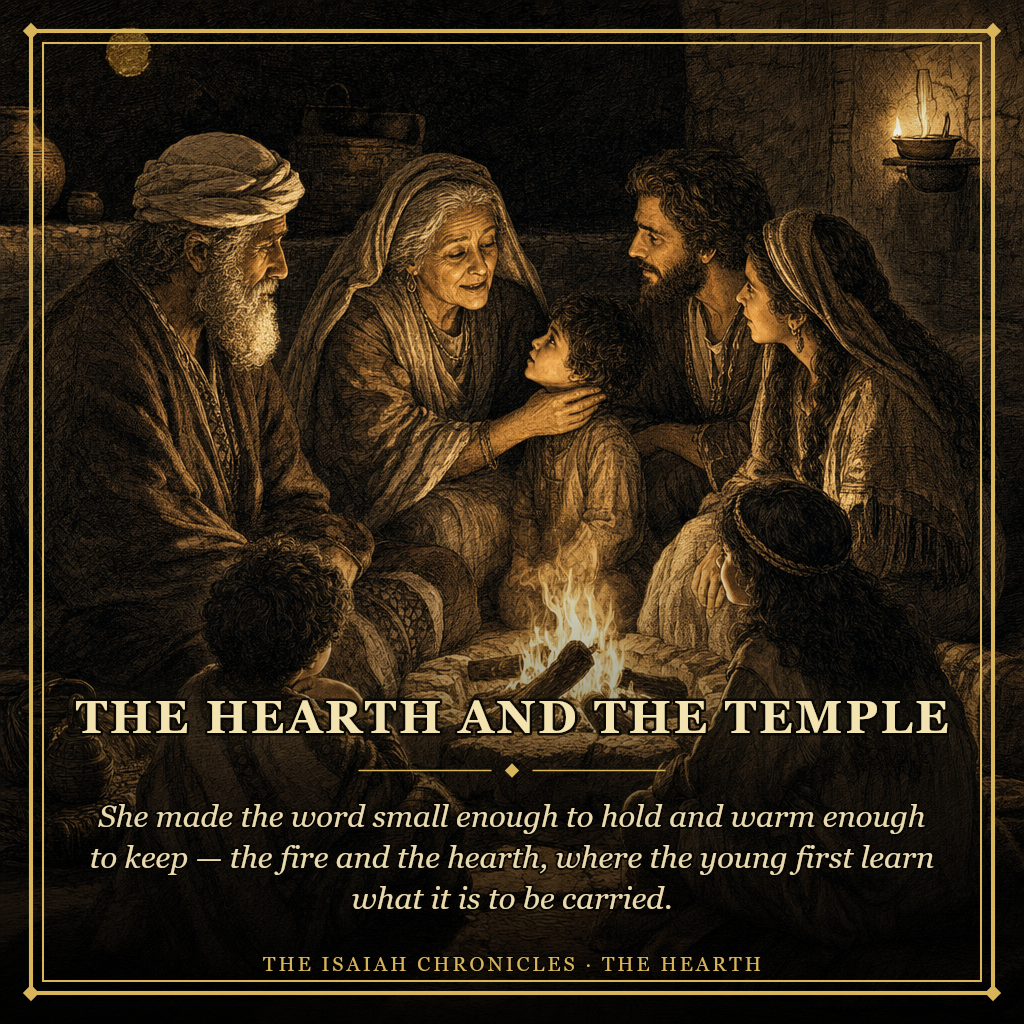
The Hearth and the Temple
H-05MAIN

The fire and the hearth, where the young first learn what it is to be carried.

In ancient Israelite households, the mother was the first teacher of Torah. Long before a son stood in the temple courts, he sat at his mother's fire and heard the word shaped into story. Hodijah's hearth was Isaiah's first pulpit — and the children's first sanctuary.

📜 Isaiah 2:3

Read Book 1. The hearth is where the story begins.

Book One · Fact Bank

Explore all cards

The Hezekiah Bulla
B1-01MAIN

This is real. It's in a museum. It's the world of this novel.

The seal impression (bulla) of King Hezekiah of Judah — the king Isaiah served — was excavated in the Ophel, Jerusalem. It bears a winged sun-disk and the Hebrew inscription "Belonging to Hezekiah, [son of] Ahaz, king of Judah." The man Isaiah whispered to left a fingerprint in the dirt.

📜 Isaiah 36–37

Read Book 1. The king whose seal this is appears in the story.

The Siloam Inscription
B1-02FORWARD

This is real. It's in a museum. It's the world of this novel.

The Siloam Inscription records the moment two teams of tunnelers, digging from opposite ends, broke through to meet under Jerusalem — Hezekiah's tunnel, built to secure the city's water supply before the Assyrian siege. The workers could hear each other's picks through the rock.

📜 2 Kings 20:20

Read Book 1. The tunnel is in the story.

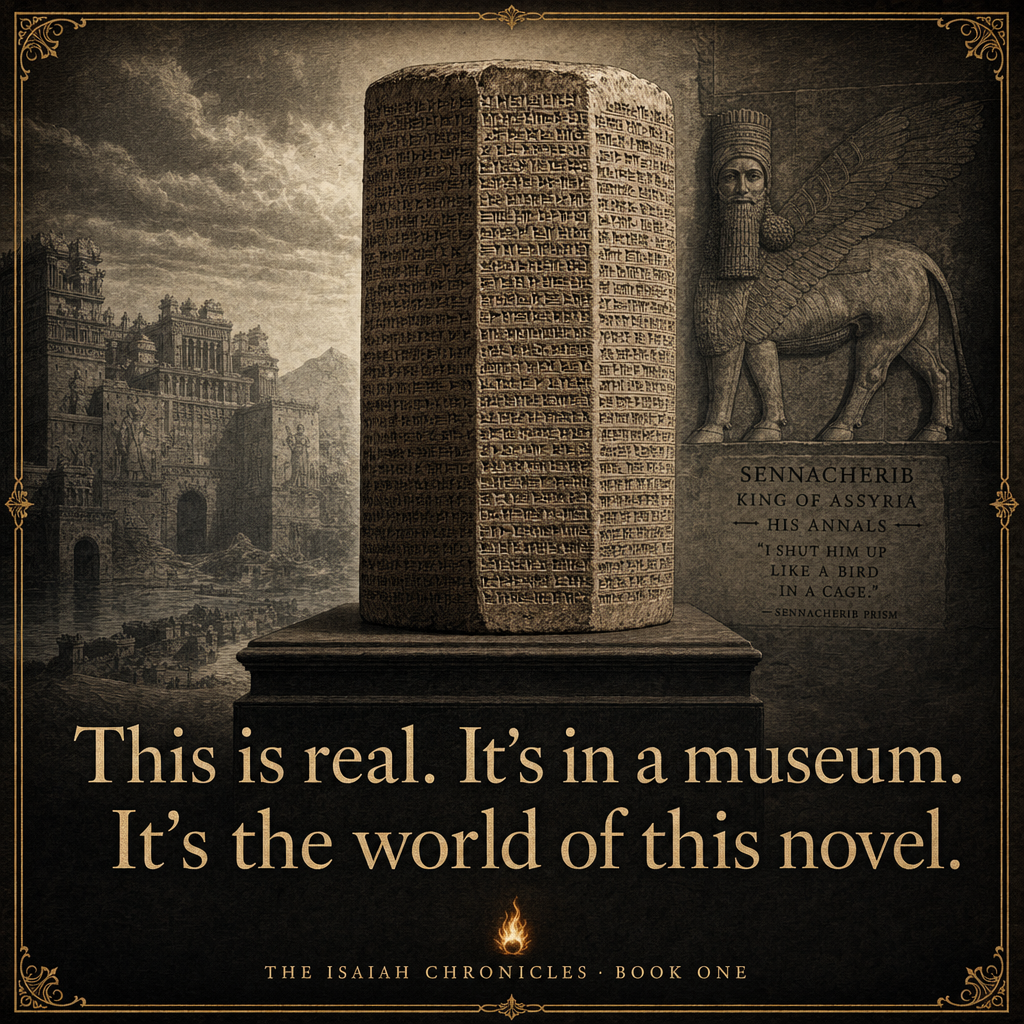
The Sennacherib Prism
B1-03MAIN

This is real. It's in a museum. It's the world of this novel.

The Sennacherib Prism records the Assyrian king's own account of his siege of Jerusalem: "I shut up Hezekiah the Judahite like a bird in a cage." He boasts of surrounding the city — but never claims to have taken it. Isaiah told Hezekiah it wouldn't fall. It didn't.

📜 Isaiah 37:33–35

Read Book 1. The siege is the climax.

The Lachish Reliefs
B1-04FORWARD

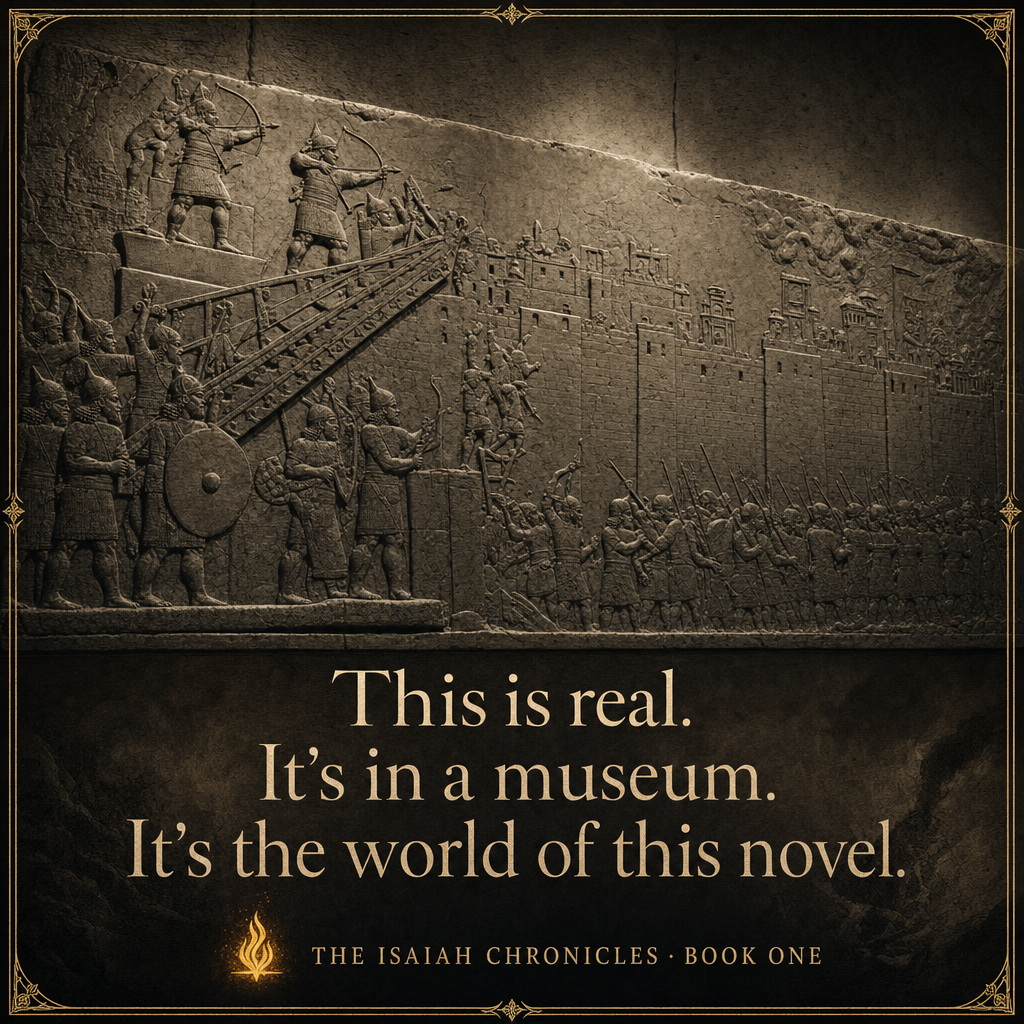
This is real. It's in a museum. It's the world of this novel.

Sennacherib was so proud of his conquest of Lachish — Judah's second city — that he covered an entire room of his palace with reliefs depicting the siege. The Judahites being marched into exile are carved in stone. Isaiah watched this happen from Jerusalem.

📜 2 Kings 18:13–14

Read Book 1. Lachish falls in the story.

The Broad Wall
B1-05SIDEWISE

This is real. It's in a museum. It's the world of this novel.

Hezekiah built a massive new wall around Jerusalem to absorb the refugees flooding in from the northern kingdom — the wall Isaiah 22:10 says was built by tearing down houses. Archaeologists found it in the Jewish Quarter. You can stand next to it today.

📜 Isaiah 22:10

Read Book 1. The wall is in the story.

The LMLK Seal
B1-06SIDEWISE

This is real. It's in a museum. It's the world of this novel.

Hundreds of LMLK ("belonging to the king") jar handles have been found across Judah — stamped with a winged scarab or sun-disk, used to mark royal provisions. They are the fingerprints of Hezekiah's war preparation. Isaiah watched the jars being filled.

📜 2 Chronicles 32:27–29

Read Book 1. The storehouses are in the story.

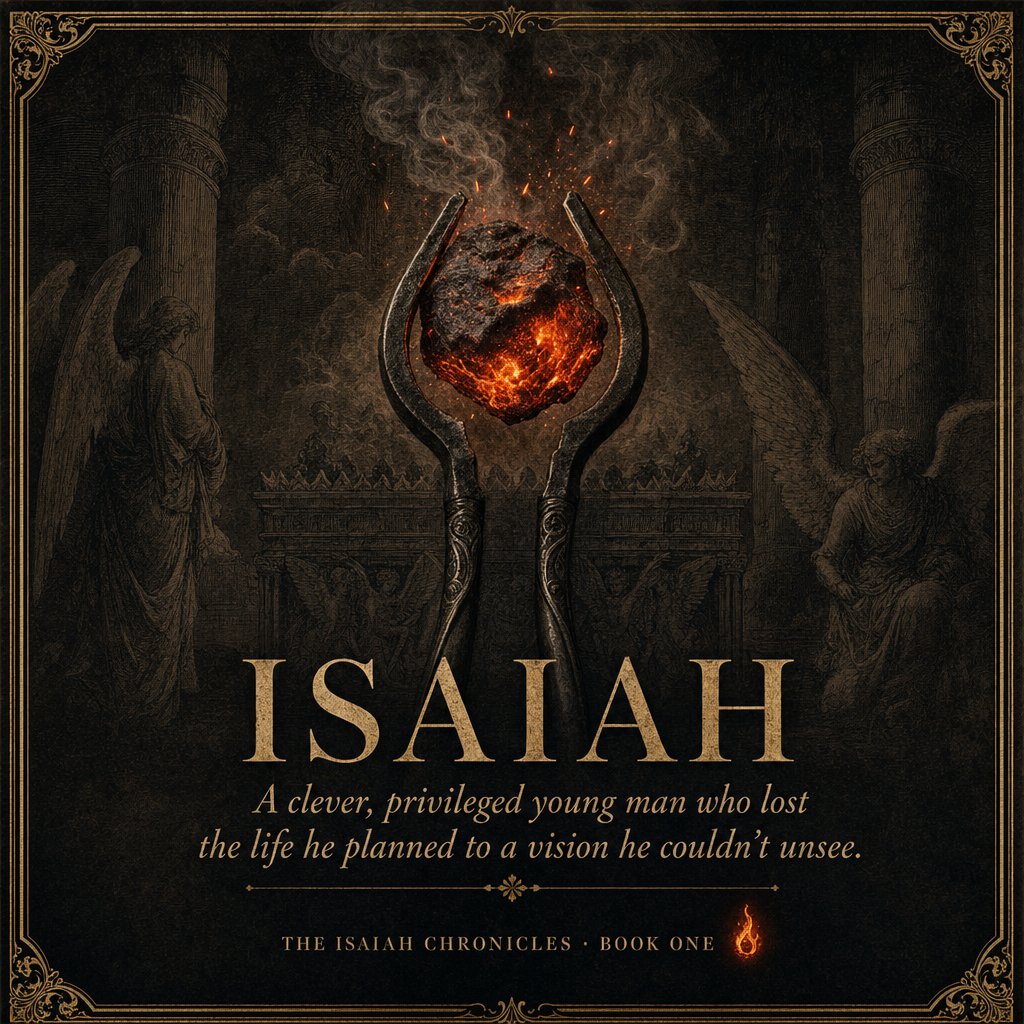
Isaiah
B1-07MAIN

He was nineteen when he saw the LORD. He never recovered. Neither will you.

Isaiah ben Amoz was a court insider — possibly of royal blood — who had access to kings and wrote the official biography of Uzziah (2 Chron 26:22). His name means "the LORD saves." He was called in the year a king died, by a coal from an altar, to say things no one wanted to hear.

📜 Isaiah 6:1–8

Read Book 1. This is his origin story.

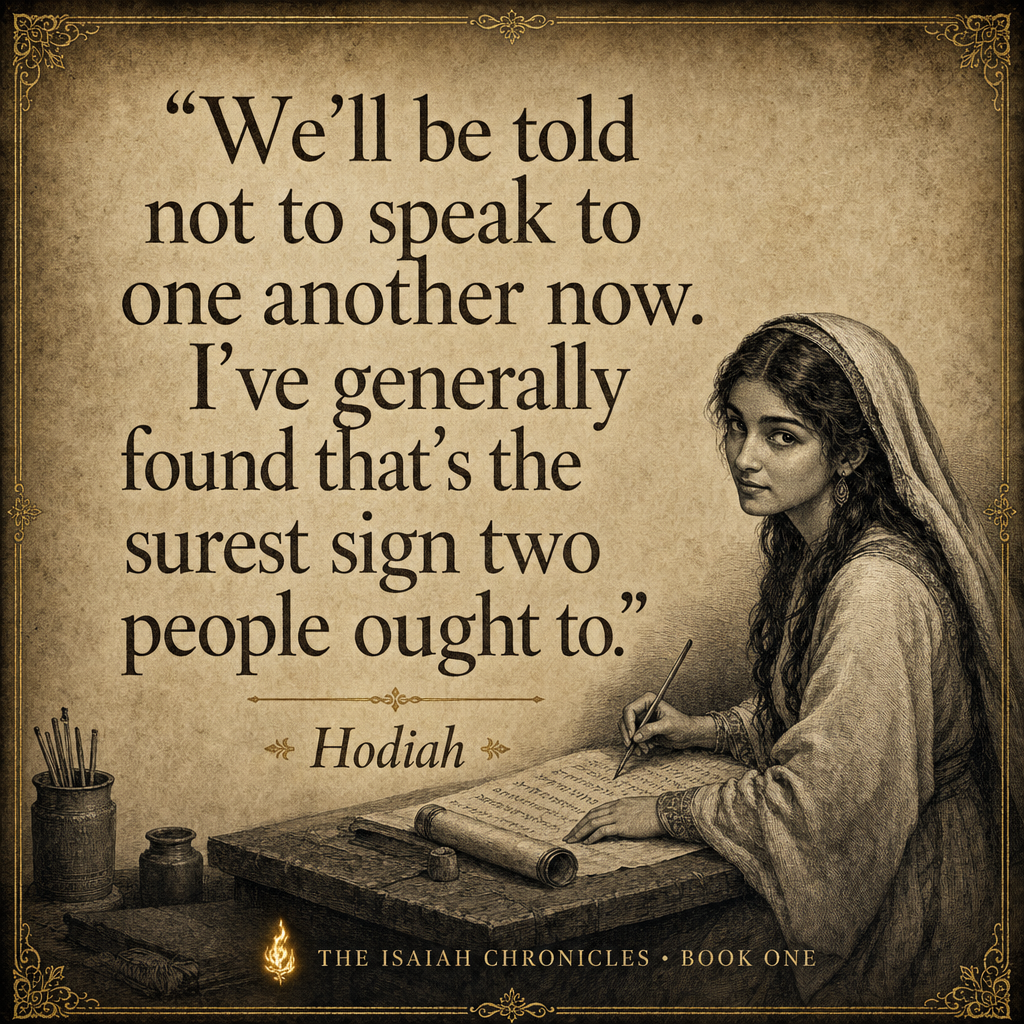
Hodijah
B1-08FORWARD

She knew exactly what she was choosing. She chose it anyway.

Hodijah ("splendor of the LORD") is Isaiah's wife, called only "the prophetess" in Isaiah 8:3. She bore children whose names were prophecies — Shear-Jashub ("a remnant shall return") and Maher-Shalal-Hash-Baz ("swift is the booty, speedy is the prey"). She raised walking sermons.

📜 Isaiah 8:3

Read Book 1. Her choice is the heart of the story.

Shear-Jashub & Maher-Shalal-Hash-Baz
B1-09MAIN

Isaiah's sons weren't just named — they were deployed.

Isaiah named his first son Shear-Jashub ("a remnant shall return") and his second Maher-Shalal-Hash-Baz ("swift is the booty, speedy is the prey") — the longest personal name in the Bible. God told him to take Shear-Jashub with him to meet the king. The boy's name was the message.

📜 Isaiah 7:3 + Isaiah 8:1–4

Read Book 1. The boys are in the story.

Advance your Discovery Guide to unlock this card.

B1-10 · Sealed

Advance your Discovery Guide to unlock this card.

B1-11 · Sealed
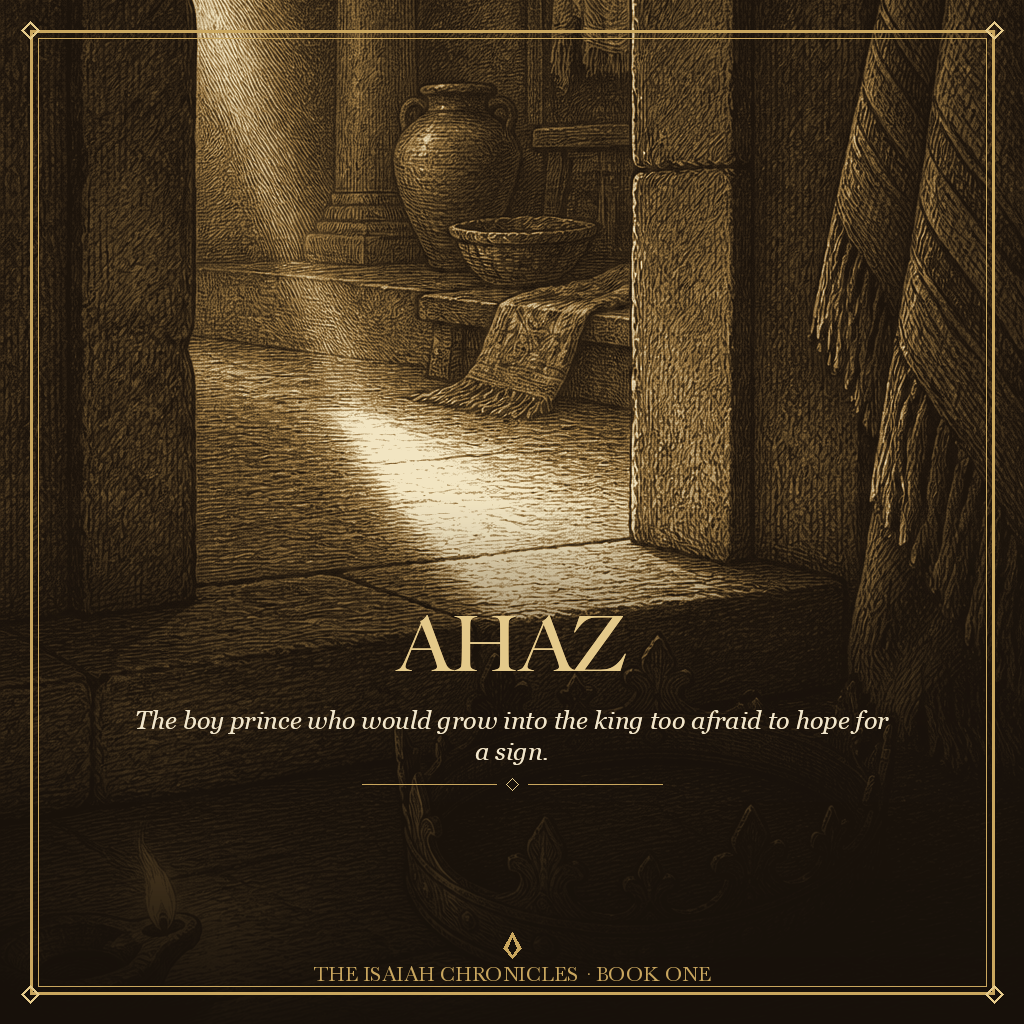
Ahaz
B1-12FORWARD

God told him to ask for a sign. He refused. That refusal changed everything.

Ahaz, king of Judah, faced an alliance of Syria and Israel threatening to replace him. Isaiah told him to ask God for any sign he wanted. Ahaz refused — and called in Assyria instead. His fear cost Judah its independence for a generation.

📜 Isaiah 7:10–13

Read Book 1. Ahaz is in the story — and his choice echoes through the series.

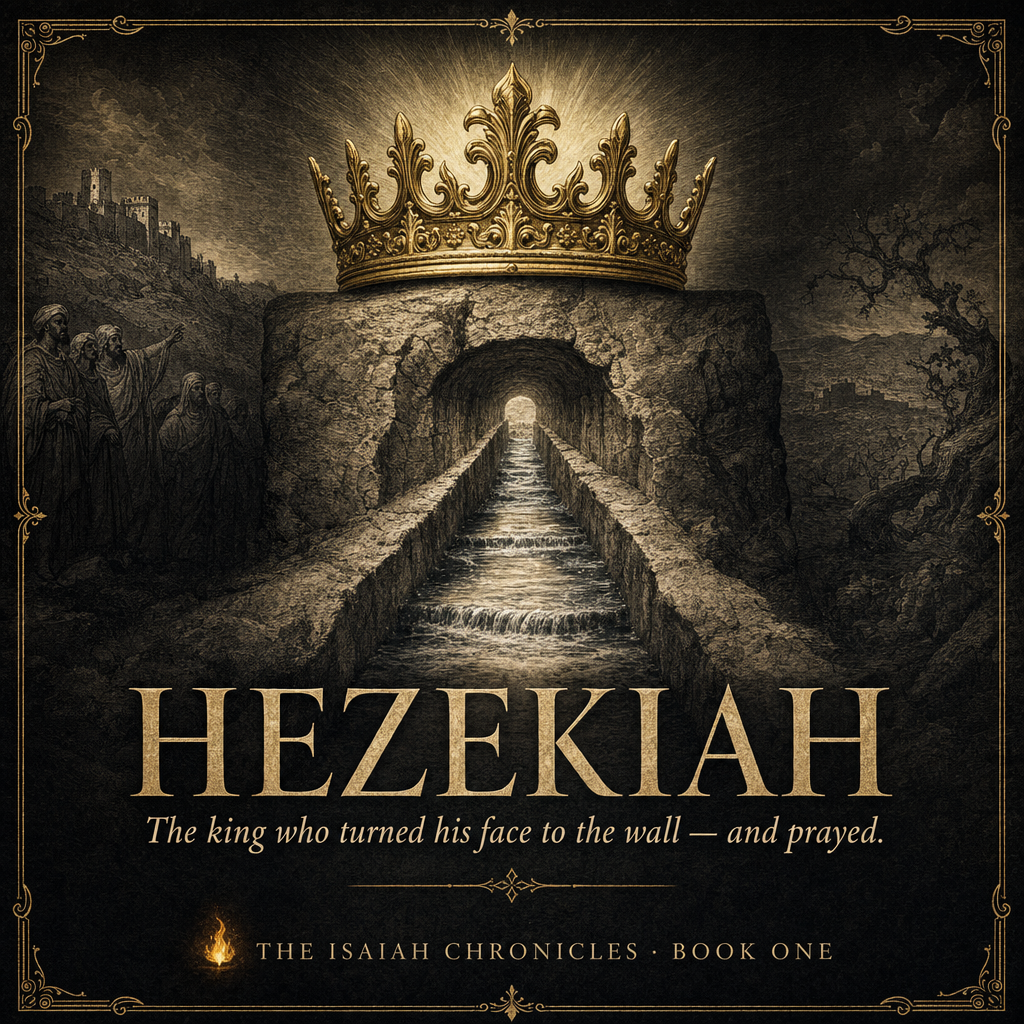
Hezekiah
B1-13MAIN

He spread the letter before the LORD. That's it. That's the whole move.

When Sennacherib's general delivered a letter demanding Jerusalem's surrender, Hezekiah took it to the temple and spread it before the LORD. Isaiah promised the army would not enter the city. That night, 185,000 Assyrian soldiers died. The siege lifted.

📜 Isaiah 37:14–36

Read Book 1. The siege is the climax — and Hezekiah's prayer is the turning point.

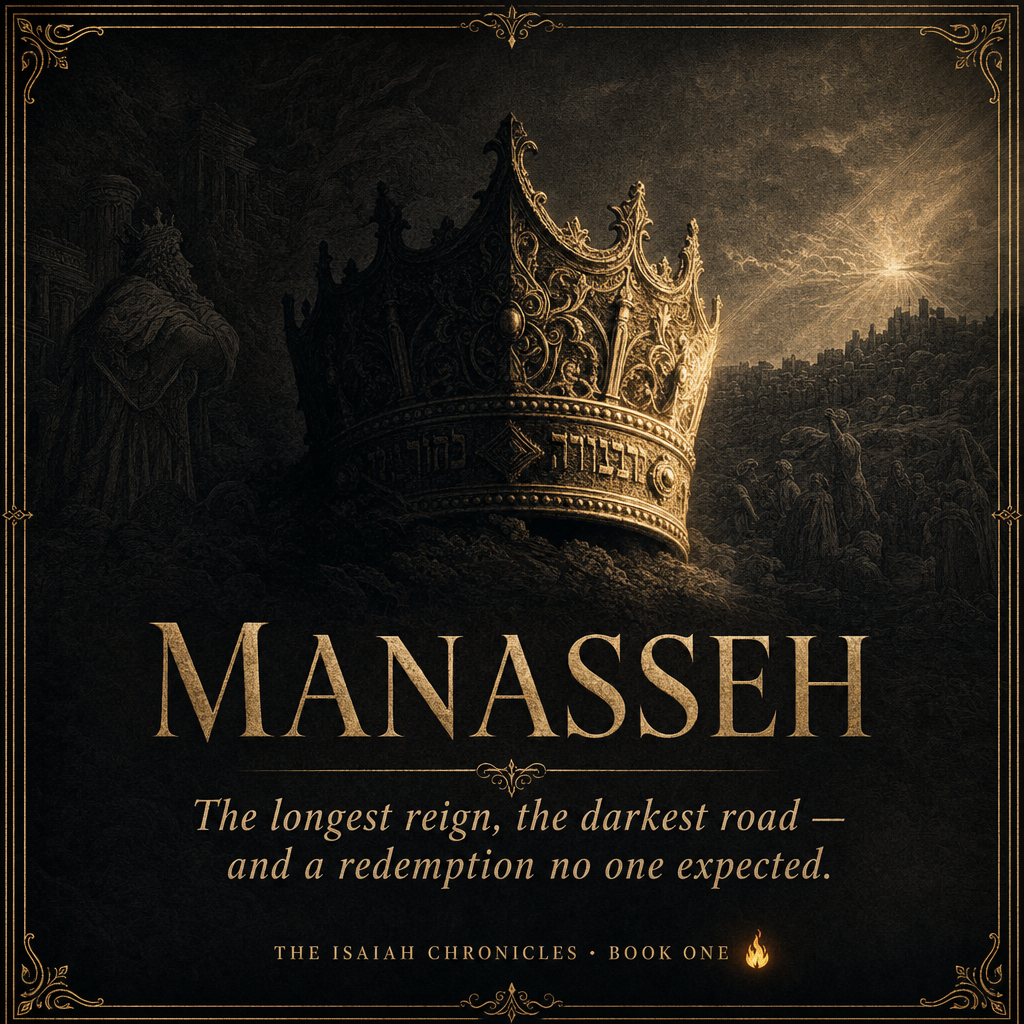
Manasseh
B1-14FORWARD

He was twelve when he became king. He reigned fifty-five years. It was not good.

Manasseh, son of Hezekiah, reversed every reform his father made — rebuilt the high places, set up altars to Baal, practiced child sacrifice, and filled Jerusalem with innocent blood. Jewish tradition holds that he had Isaiah sawn in two. He reigned longer than any king of Judah.

📜 2 Kings 21:1–16

Read Book 1. The shadow of what comes next is already in the story.

The Timeline
B1-15MAIN

Four kings. One prophet. Sixty years of history that changed everything.

Isaiah ministered through the reigns of Uzziah, Jotham, Ahaz, and Hezekiah — roughly 740–700 B.C.E. In that span: the northern kingdom fell to Assyria, Jerusalem survived a siege that destroyed every other city in its path, and the clearest prophecies of Christ in the Old Testament were written.

📜 Isaiah 1:1

Read Book 1. This is where it begins.

"Here Am I; Send Me"
B1-16BACKWARD

He said yes before he knew what he was saying yes to.

Isaiah 6:8's "Here am I; send me" is the antitype of Abraham 3:27's premortal "Here am I, send me." The yes Isaiah says at nineteen rhymes with a yes said before the earth was formed. Same words. Same voice. Different councils.

📜 Isaiah 6:8 + Abraham 3:27

Reread the call. The yes he says at nineteen rhymes with a yes said before time.

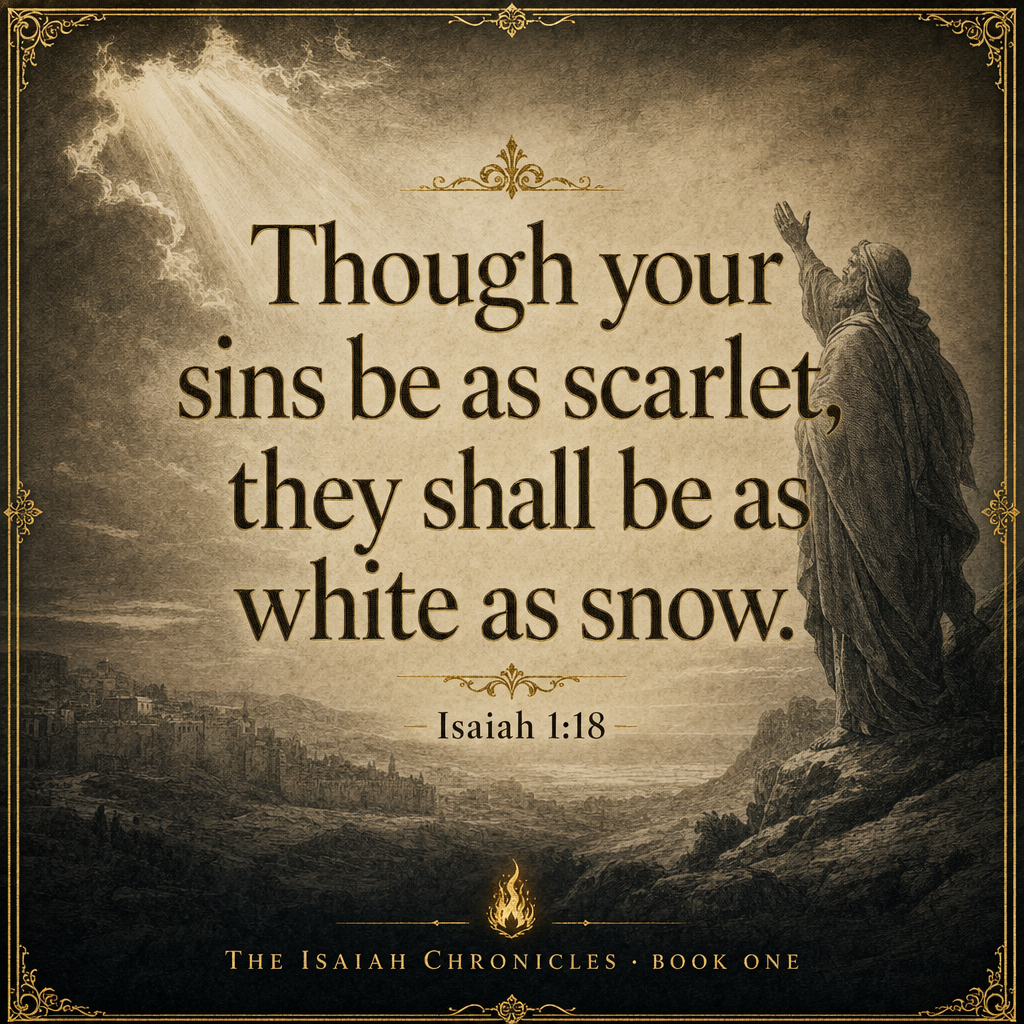
"Though Your Sins Be as Scarlet"
B1-17MAIN

The first chapter of Isaiah is not a condemnation. It's an invitation.

"Come now, and let us reason together, saith the LORD: though your sins be as scarlet, they shall be as white as snow" (Isaiah 1:18). The book opens not with judgment but with an offer. The prophet who saw the LORD on the throne begins by quoting His mercy.

📜 Isaiah 1:18

Read Book 1. The invitation is the door.

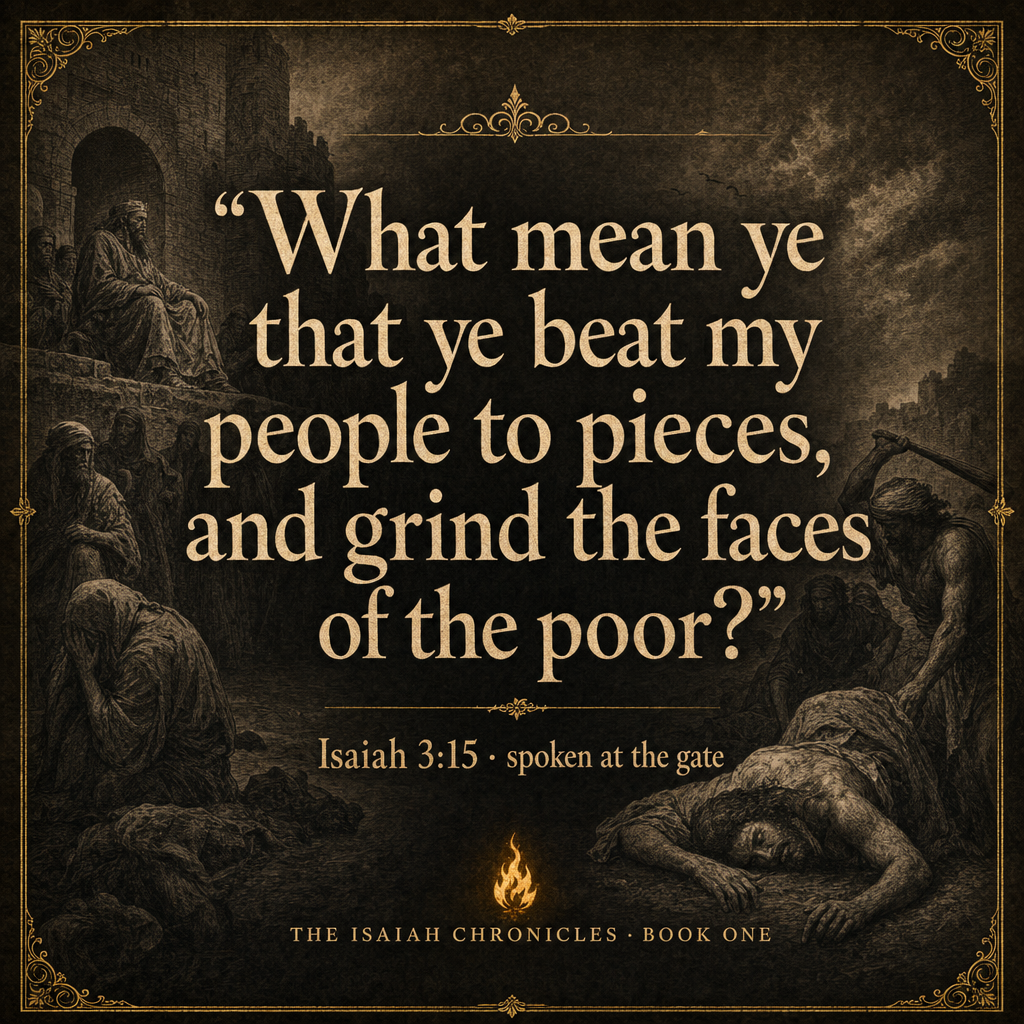
"Grind the Faces of the Poor"
B1-18FORWARD

Isaiah said things to kings that prophets don't usually survive saying.

"What mean ye that ye beat my people to pieces, and grind the faces of the poor?" (Isaiah 3:15). Isaiah said this to the rulers of Jerusalem — to their faces. He was a court insider who used his access to deliver the hardest messages. That combination is the whole story.

📜 Isaiah 3:15

Read Book 1. The courage to speak is the thread.

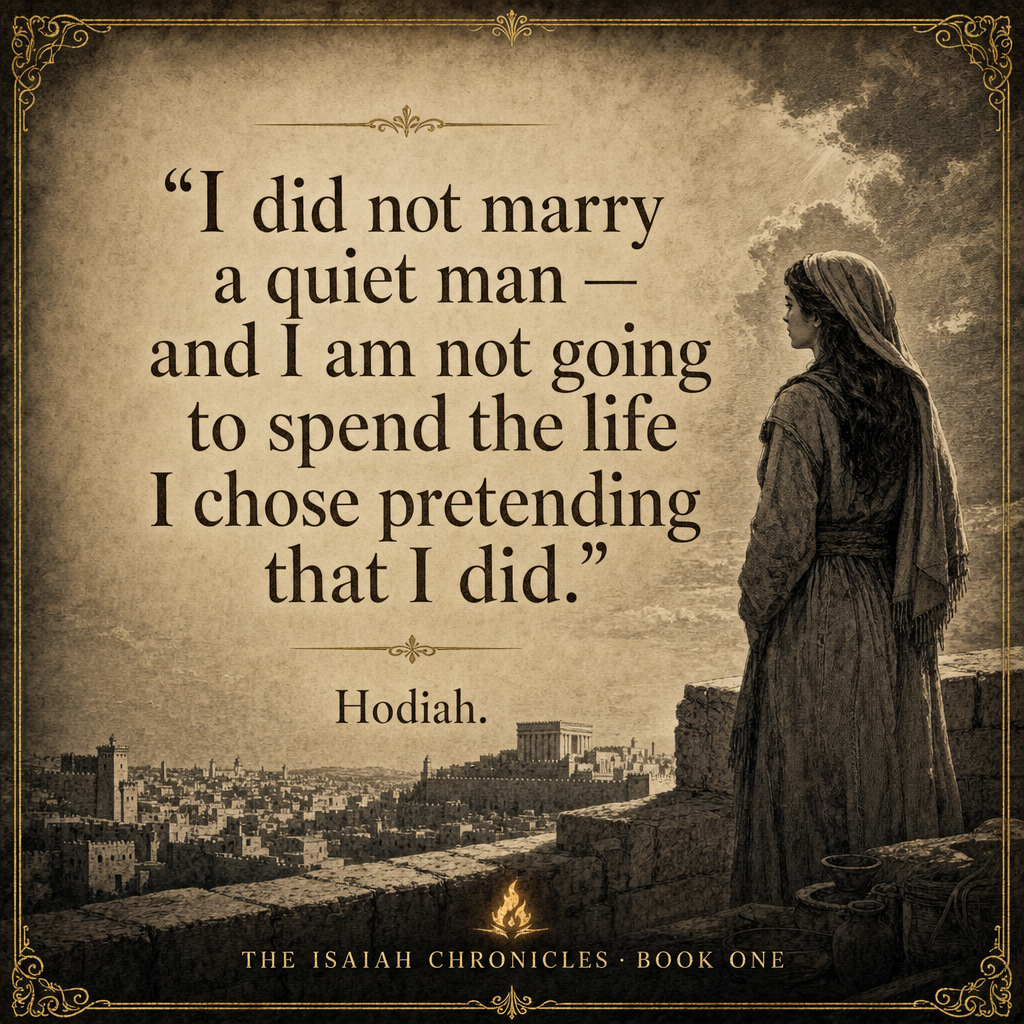
Hodijah Speaks
B1-19FORWARD

She is called only "the prophetess." The novel gives her back her voice.

Isaiah 8:3 calls her simply "the prophetess" — no name, no backstory, just a title and two sons whose names were prophecies. The Isaiah Chronicles names her Hodijah ("splendor of the LORD") and gives her the voice scripture left silent. She knew exactly what she was choosing.

📜 Isaiah 8:3

Read Book 1. Her choice is the heart of the story.

The Quiet Man
B1-20MAIN

She didn't marry a safe man. She married a true one.

The Isaiah Chronicles portrays Isaiah not as a thundering figure but as a quiet, precise, deeply observant young man — someone whose gift made him strange and whose strangeness made him lonely, until Hodijah. The novel is as much her story as his.

📜 Isaiah 8:3

Read Book 1. This is his origin story — and hers.

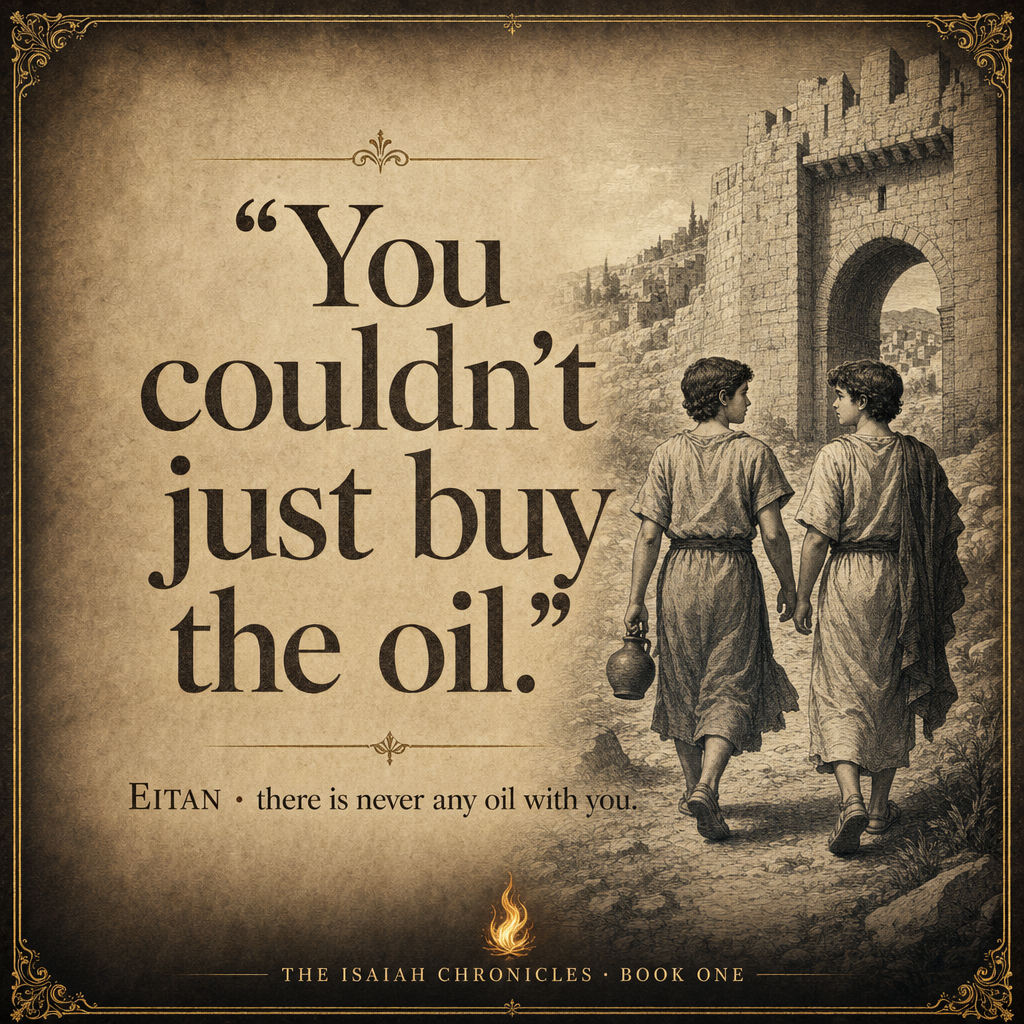
Eitan & the Oil
B1-21SIDEWISE

Not every thread belongs to a prophet.

The Isaiah Chronicles weaves in characters who never appear in scripture — merchants, gatekeepers, servants — whose ordinary lives intersect with the extraordinary events Isaiah is living through. Eitan is one of them. His story is Book-1-safe. His thread runs further.

📜 Isaiah 1:1

Read Book 1. Watch for the oil.

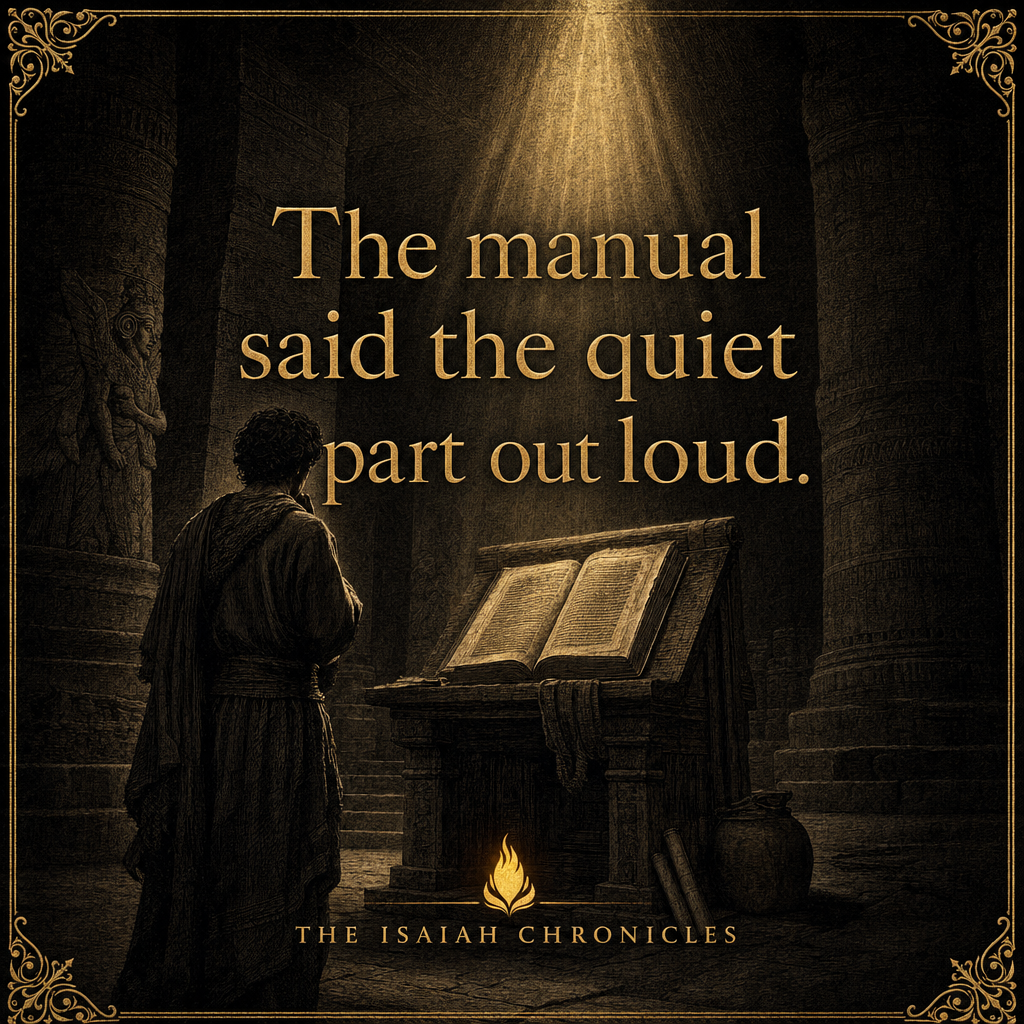
The Manual Said the Quiet Part Out Loud
FD-01MAIN

The manual said the quiet part out loud.

Isaiah was a court insider who used his access to deliver the hardest messages. He said things to kings that prophets don't usually survive saying. That combination — access and courage — is the whole story.

📜 Isaiah 3:15

Read Book 1. The courage to speak is the thread.

Everybody Skips Him. This Is the Year to Stop.
FD-02MAIN

Everybody skips him. This is the year to stop.

Isaiah is the most-quoted prophet in the New Testament (~60 direct quotes, ~350 allusions). The man you were taught to skip is the man scripture won't stop citing.

📜 Isaiah 1:1

Read Book 1. Start where he starts.

Isaiah Isn't Hard. He Was Just Never Introduced to You.
FD-03FORWARD

Isaiah isn't hard. He was just never introduced to you.

The Isaiah Chronicles is the introduction Isaiah never got. Historical fiction grounded in verifiable archaeology, scripture, and the world Isaiah actually lived in.

📜 Isaiah 6:1

Read Book 1. This is the introduction.
The 'Boring' Chapters Are Hiding Jesus in Plain Sight
FD-04MAIN

The 'boring' chapters are hiding Jesus in plain sight.

John 12:41 — "These things said Esaias, when he saw his glory, and spake of him." The One on the throne of Isaiah 6 is the premortal Christ. The chapters you skip are the ones hiding Him.

📜 Isaiah 6:1–5 + John 12:41

Read Book 1. The face on the throne keeps turning.

If You Can Love a Story, You Can Love Isaiah
FD-05FORWARD

If you can love a story, you can love Isaiah.

The Isaiah Chronicles pairs the prophet's world with the story of the people who lived it — kings, prophets, wives, servants. If you can love a story, Isaiah is already yours.

📜 Isaiah 1:1

Read Book 1. The story is the door.

Isaiah Is a Locked Room. Here Are the Keys.
FD-06MAIN

Isaiah is a locked room. Here are the keys.

The Reader's Companion (Book Nine) is the key set — archaeology, Hebrew context, Christological patterns, and the master mystery explained. The locked room opens.

📜 Isaiah 29:11

Read Book 1 first. The Companion unlocks after.

Come for the Mystery. Stay for the Messiah.
FD-07MAIN

Come for the mystery. Stay for the Messiah.

The Isaiah Chronicles is built around one master mystery: whose face is on the throne of Isaiah 6? The answer runs through every book — and changes everything you thought you knew about the prophet.

📜 Isaiah 6:1 + John 12:41

Read Book 1. The mystery begins here.

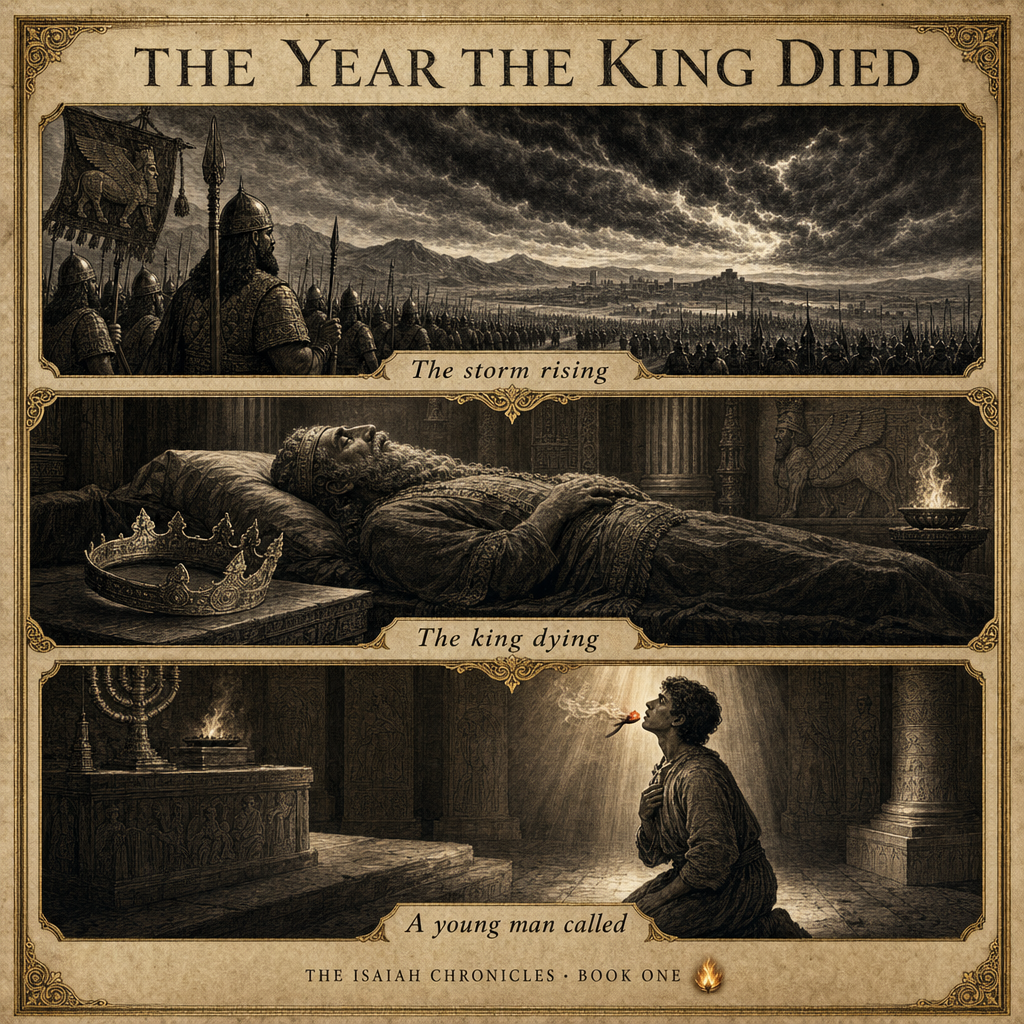
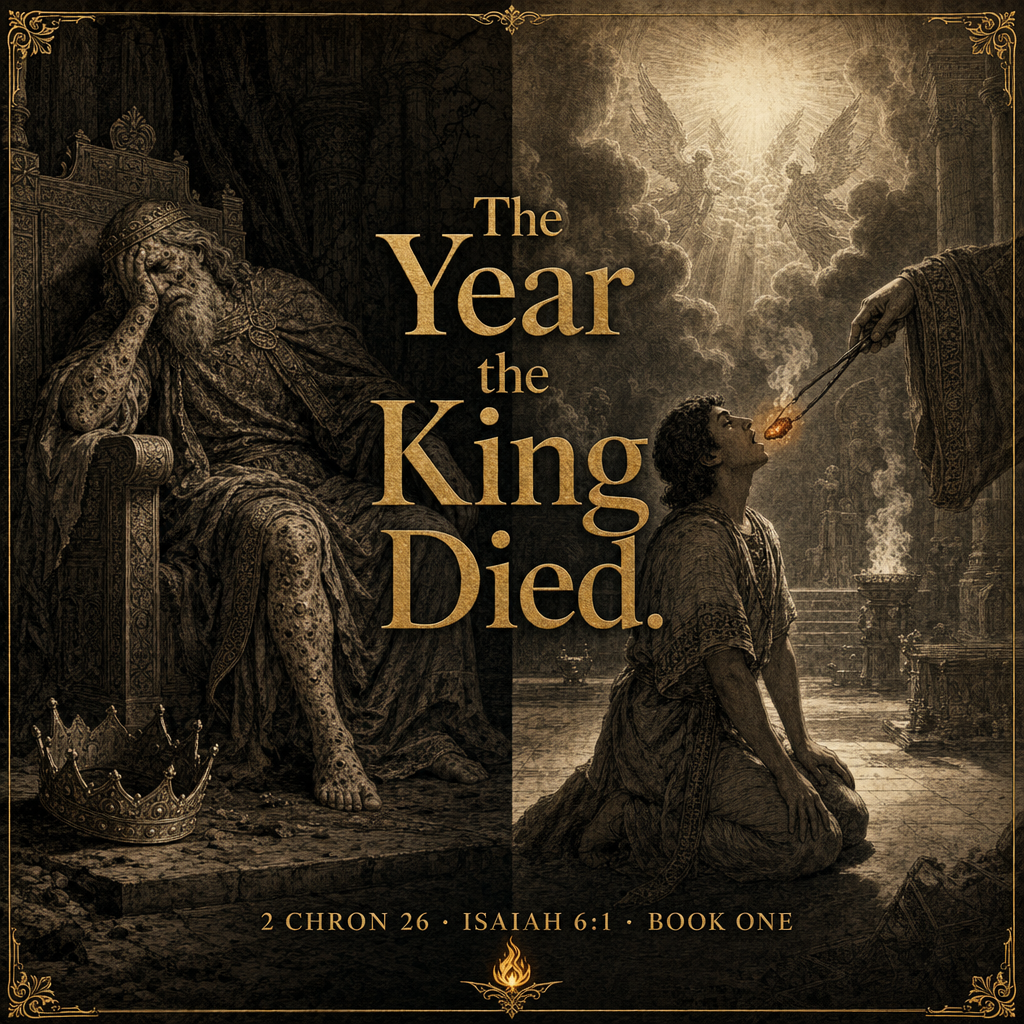
The Year the King Died
CFM-BMAIN

The year the king died, Isaiah saw the LORD.

In the year King Uzziah died (c. 740 BC), Isaiah received his throne-room vision. The death of one king opened the vision of another. 2 Chronicles 26 and Isaiah 6:1 are the same moment — one political, one eternal.

📜 2 Chron 26 · Isaiah 6:1

Read Book 1. This is where it begins.

Whose Face Was on the Throne?
CFM-CMAIN

Whose face was on the throne?

John 12:41 answers the question Isaiah 6 raises: "These things said Esaias, when he saw his glory, and spake of him." The face on the throne was the premortal Christ. Isaiah knew it. John confirmed it.

📜 Isaiah 6 · John 12:41

Read Book 1. The face on the throne is the whole story.

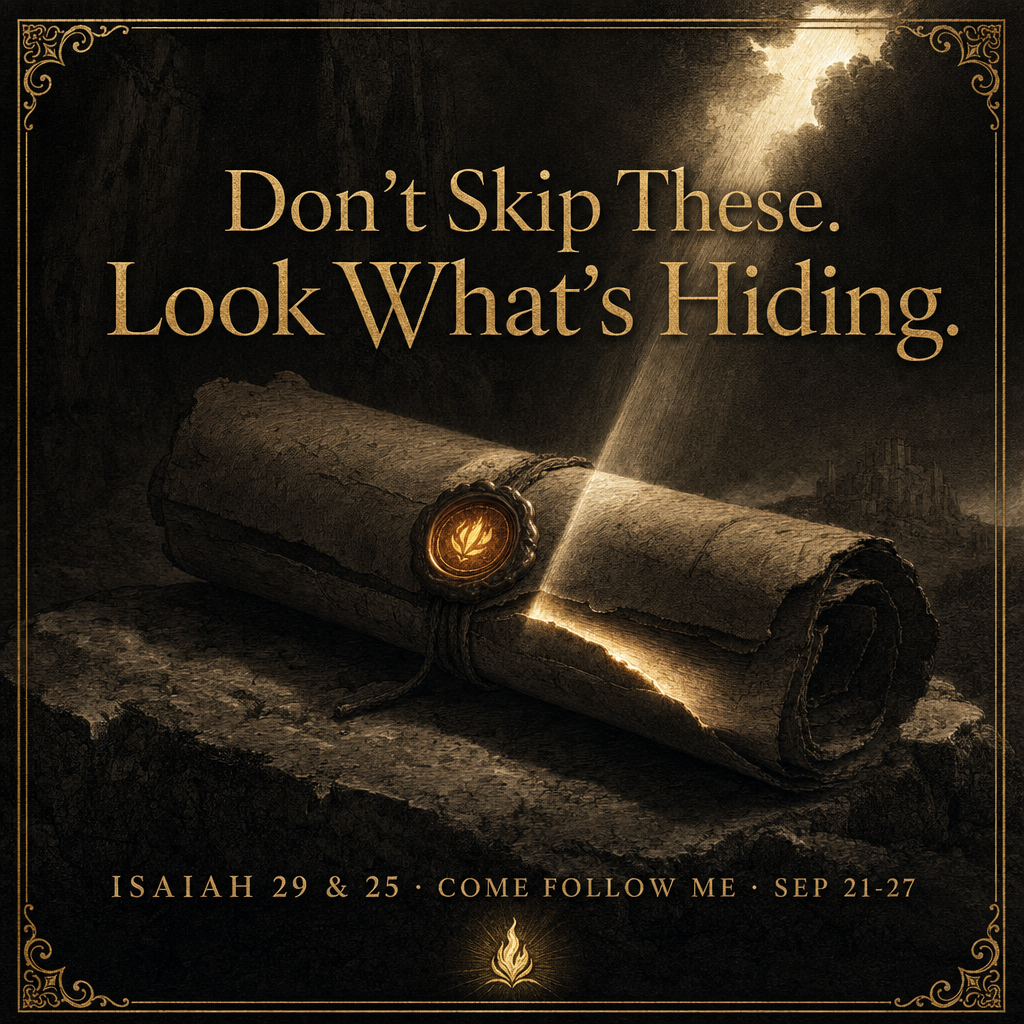
Don't Skip These. Look What's Hiding.
CFM-DMAIN

Don't skip these. Look what's hiding.

Isaiah 29 contains one of the most specific prophecies in all of scripture — a sealed book, a marvelous work, a people who draw near with their lips. The Book of Mormon and the Restoration are hiding in plain sight. Come Follow Me: Sep 21–27.

📜 Isaiah 29 & 25

Read the sealed book chapters. The light is already there.

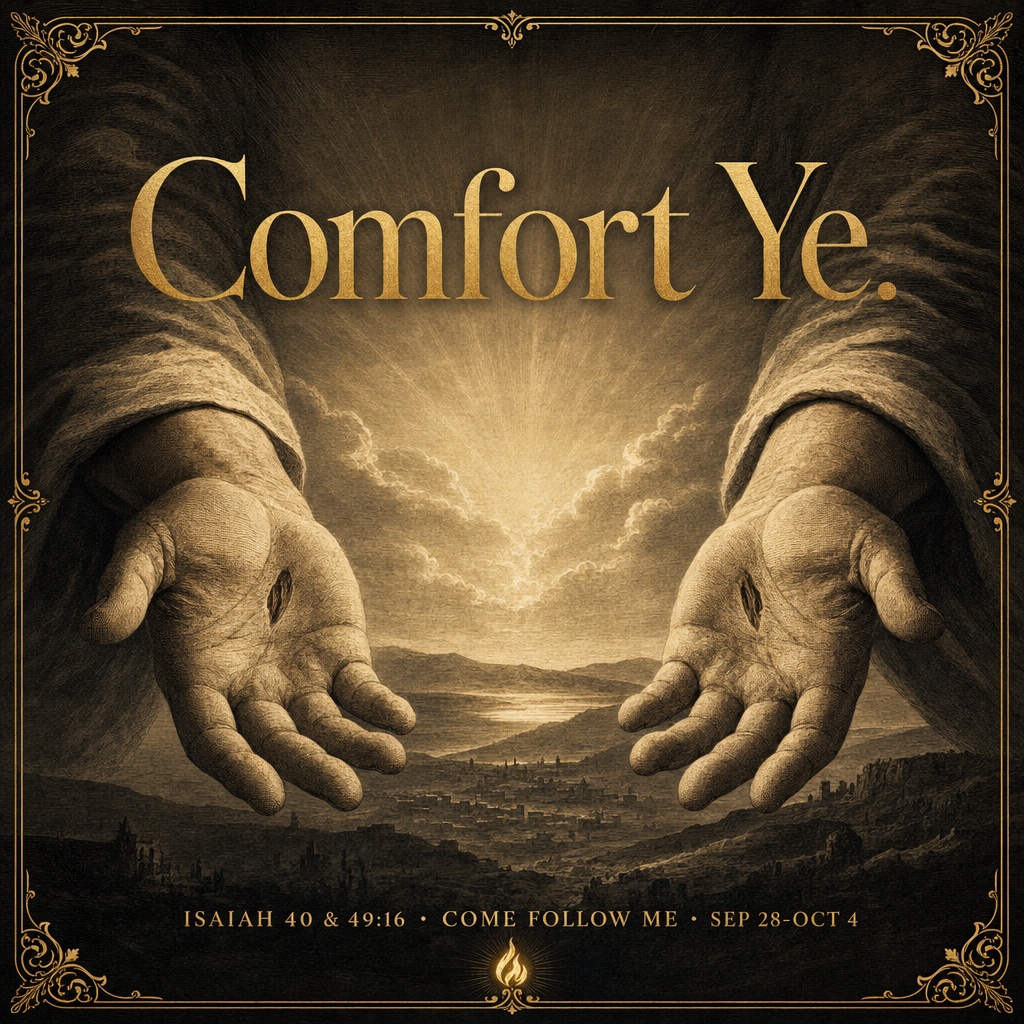
Comfort Ye.
CFM-EFORWARD

Comfort ye, comfort ye my people.

Isaiah 40 opens the second movement of the book — from judgment to comfort. "He hath graven thee upon the palms of his hands" (49:16). The wounds are the proof. Come Follow Me: Sep 28–Oct 4.

📜 Isaiah 40 & 49:16

Read Isaiah 40. The comfort is real.

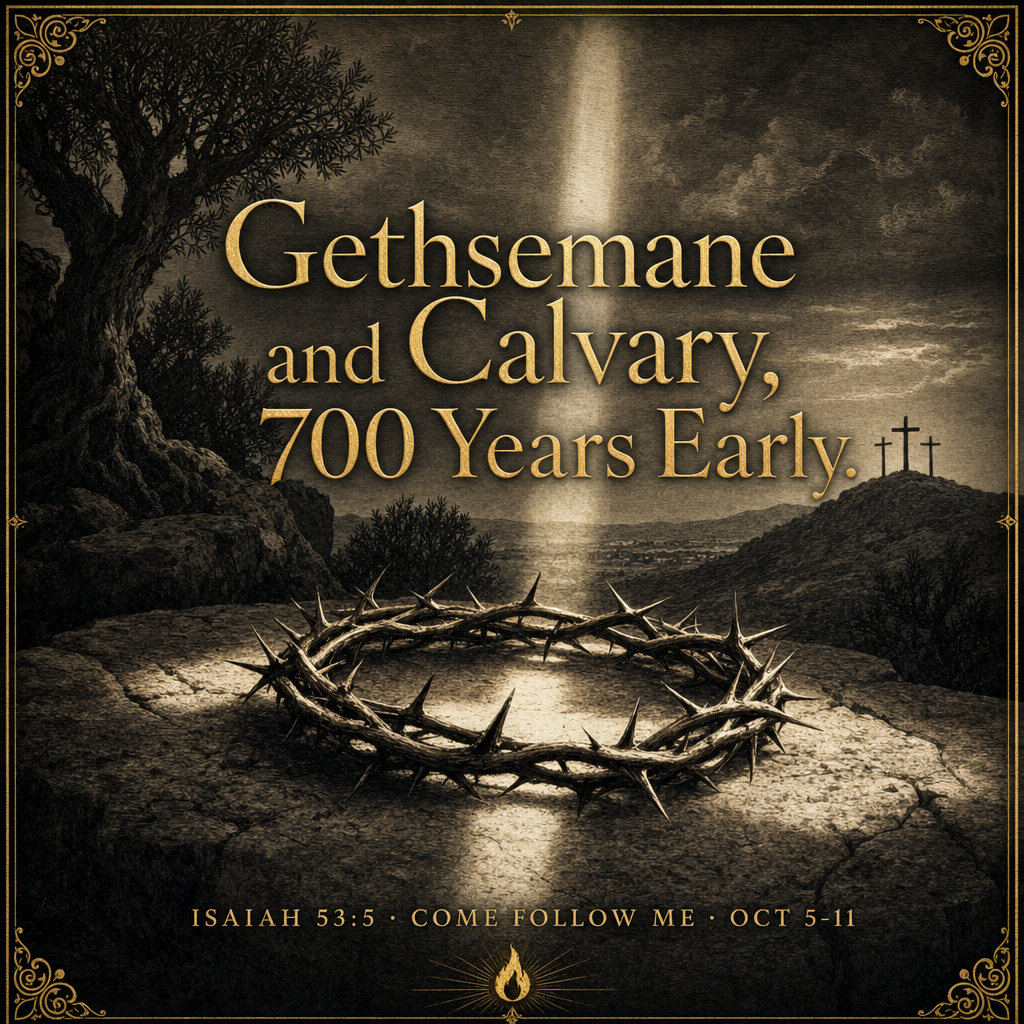
Gethsemane and Calvary, 700 Years Early.
CFM-FMAIN

He was wounded for our transgressions.

Isaiah 53 describes the suffering servant with surgical precision — bruised, pierced, silent before his accusers. Written 700 years before Gethsemane. Come Follow Me: Oct 5–11.

📜 Isaiah 53:5

Read Isaiah 53. Every word is a prophecy fulfilled.

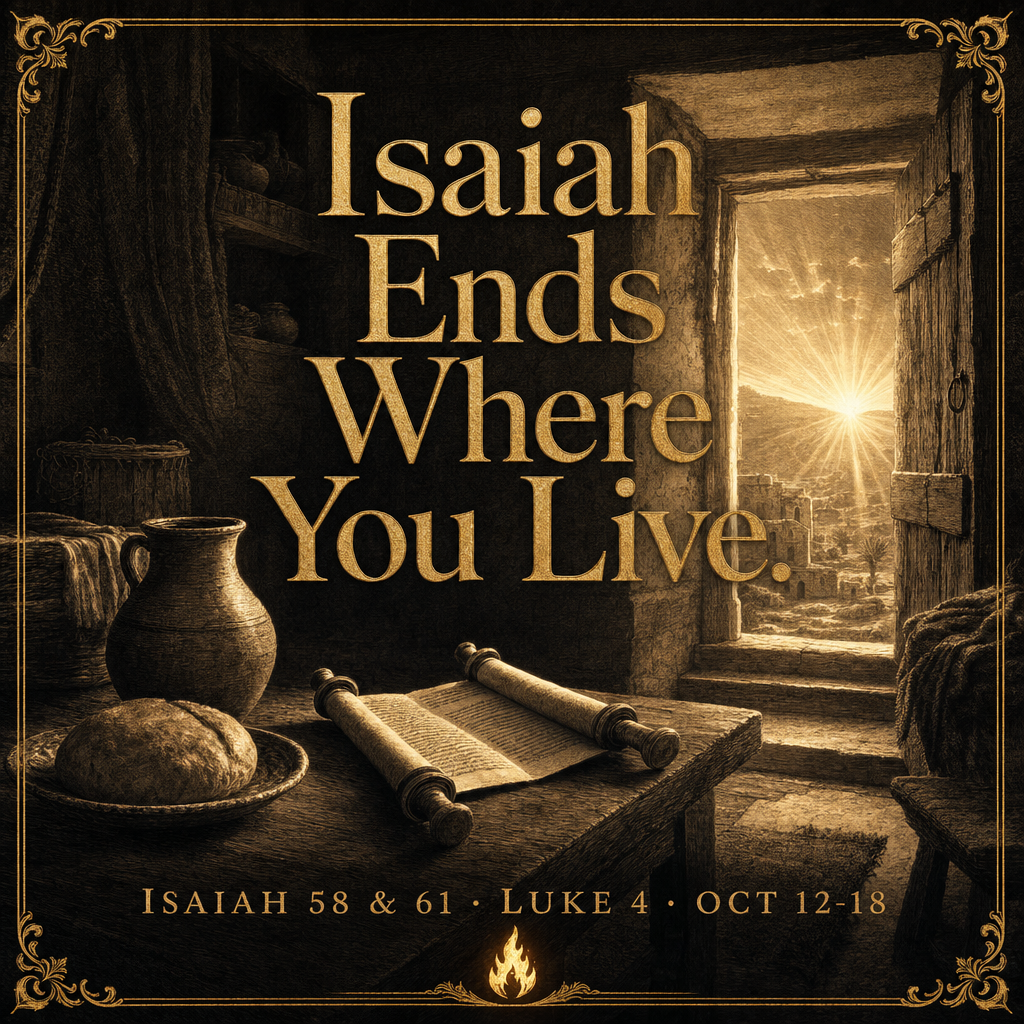
Isaiah Ends Where You Live.
CFM-GFORWARD

The Spirit of the Lord is upon me.

Isaiah 61 is the text Jesus read in Nazareth — "This day is this scripture fulfilled in your ears." Isaiah doesn't end in ancient Judah. It ends in your neighbourhood. Come Follow Me: Oct 12–18.

📜 Isaiah 58 & 61 · Luke 4

Read Isaiah 61. Then read Luke 4. Same words, same voice.

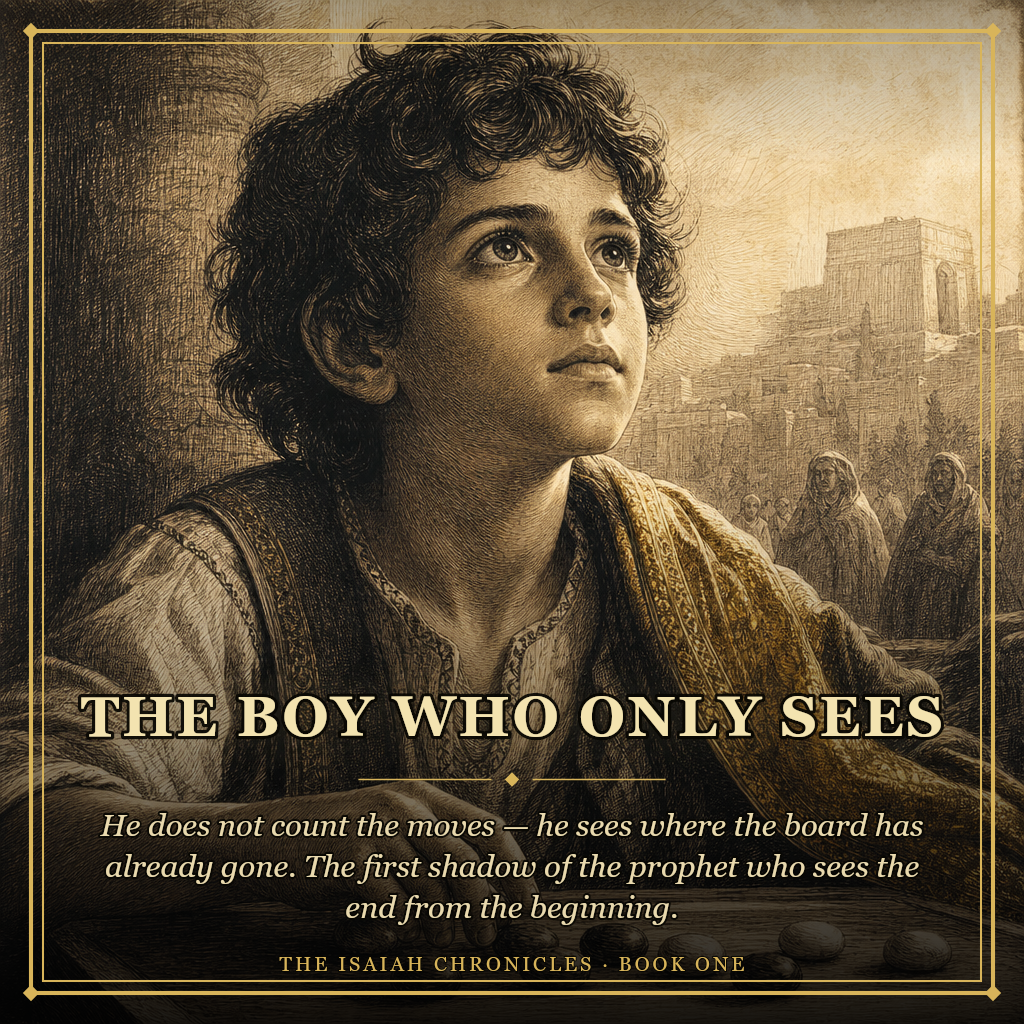
The Boy Who Only Sees
DC-02MAIN

He doesn't count the moves. He sees where the board has already gone.

In the opening pages of The Year the King Died, Eitan sits at the city gate playing Nine Men's Morris against merchants and soldiers — and wins, consistently, against men who calculate every move. They count. He sees. The difference is the whole point of the book.

📜 Isaiah 6:1

Read Book 1. The boy at the gate is the first door.

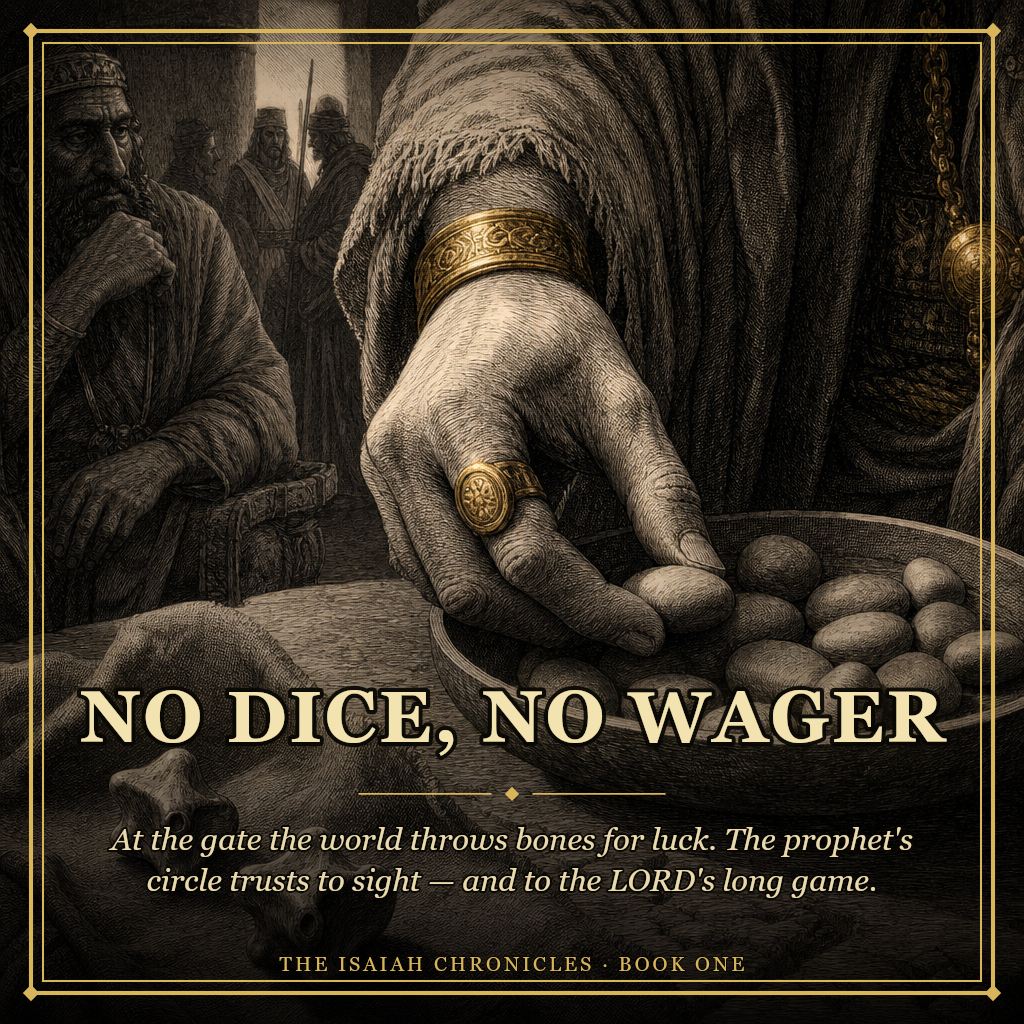
No Dice. No Wager.
DC-03FORWARD

No dice. No wager. Pure strategy, pure sight.

Nine Men's Morris boards have been found carved into temple roofing slabs in Egypt dated to around 1400 B.C.E. — the game was ancient when Isaiah was young. No dice, no luck, no chance. Pure strategy, pure sight. It is the recurring ornament of the series.

📜 Isaiah 1:3

Read Book 1. The game at the gate is not decoration.
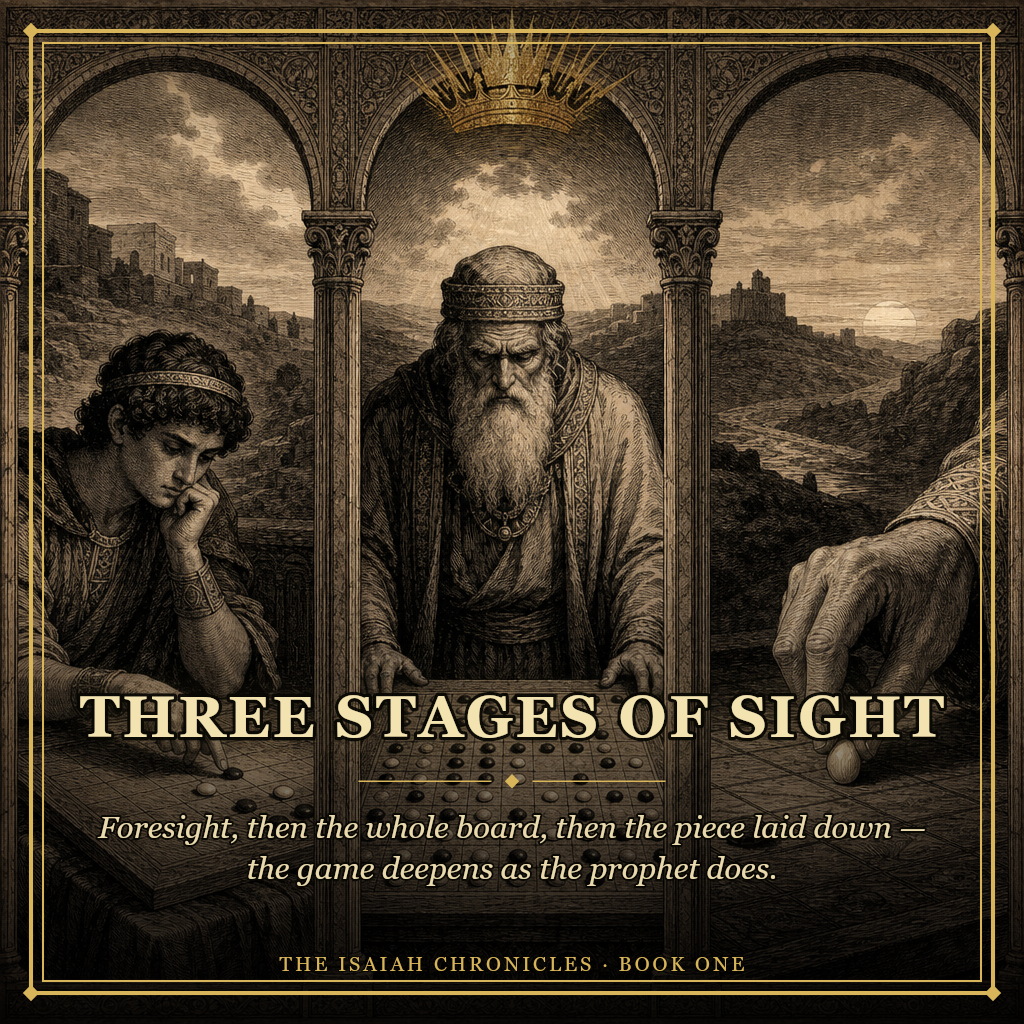
Three Stages of Sight
DC-05MAIN

First you see the move. Then the board. Then the whole game.

The three phases of Nine Men's Morris — Place, Move, Fly — mirror the three stages of prophetic sight in the novel: the child who sees one move ahead, the prophet who sees the whole board, and the Servant who sees the end from the beginning and lays down the piece that wins.

📜 Isaiah 46:10

Read Book 1. The three stages begin at the gate.

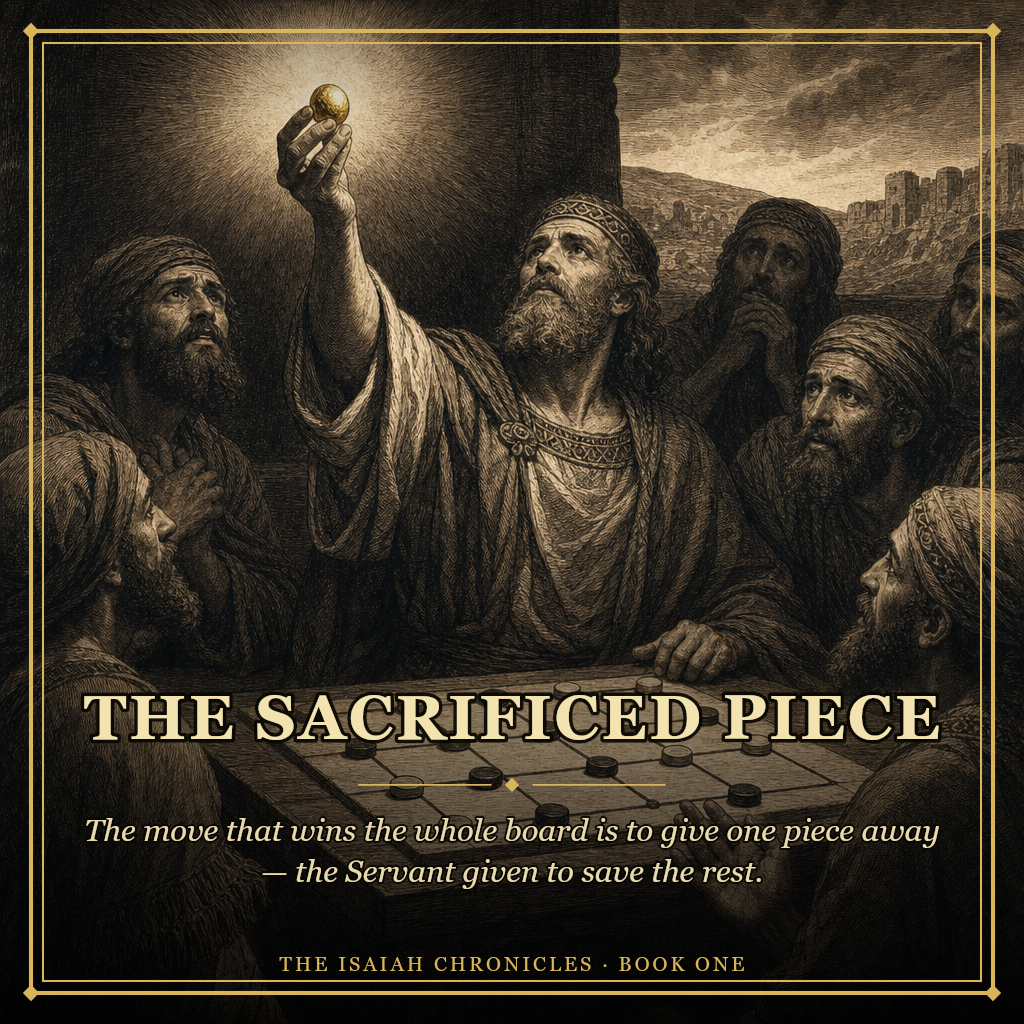
The Sacrificed Piece
DC-06MAIN

The move that wins the whole board is to give one piece away.

In Nine Men's Morris, the player who loses all but three pieces enters the flying phase — and becomes, briefly, the most dangerous player on the board. T.M. Krieg uses this moment in Book One as a quiet image of what it means to be stripped down to almost nothing and still be the instrument of the LORD's purpose.

📜 Isaiah 53:10

Read Book 1. The sacrificed piece is the whole story.

The Word and the Weight
H-01MAIN

He carries the word. She carries him.

Isaiah 8:3 names her only as "the prophetess" — but she is the one who bears the sign-children, who keeps the household when the prophet is summoned to the palace, and who holds the weight of a calling that was never only his. The word came to Isaiah. The word cost Hodijah.

📜 Isaiah 8:3

Read Book 1. The word and the weight begin on the same page.

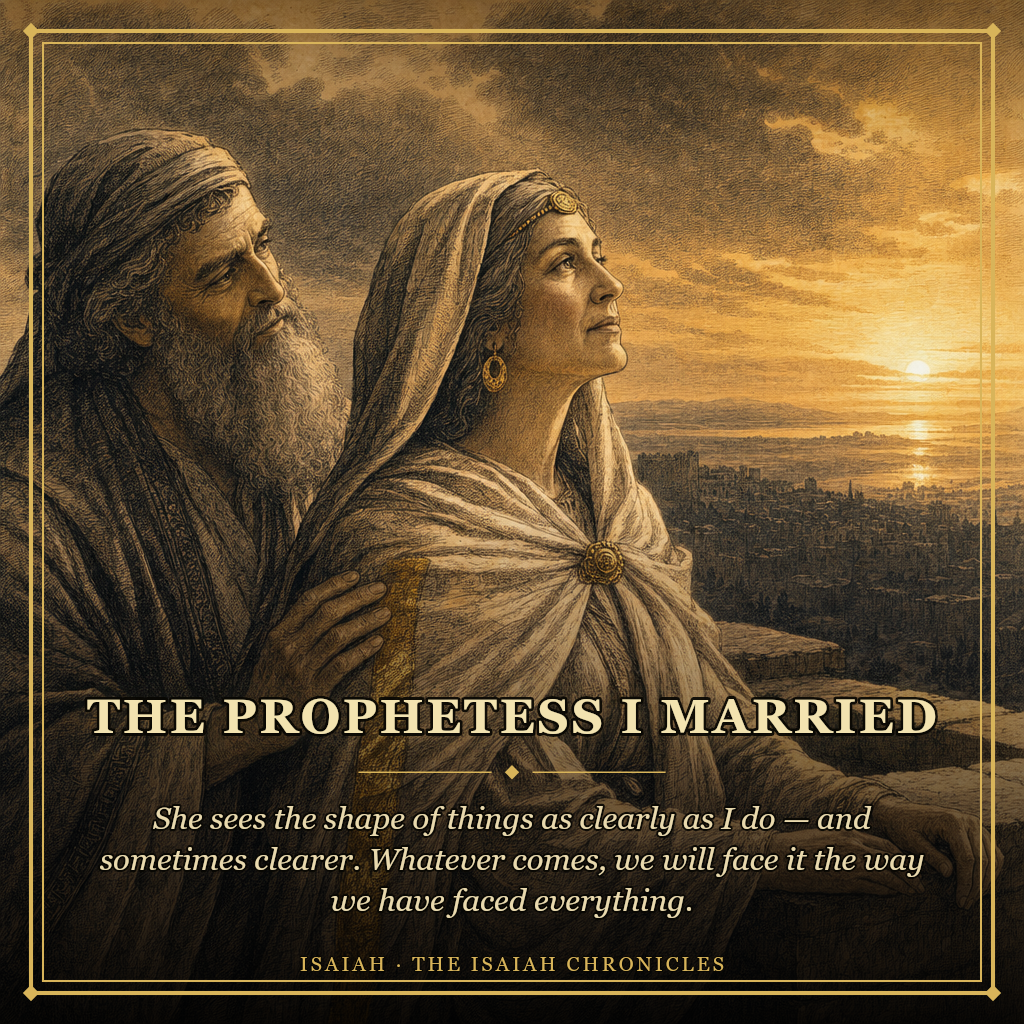
The Prophetess I Married
H-02FORWARD

She did not receive the calling. She received the man who did.

The Bible calls her "the prophetess" — a title that may mean she prophesied herself, or simply that she was married to the prophet. Either way, she is the only woman in Isaiah's household named by role. T.M. Krieg gives her a name, a voice, and a chapter of her own.

📜 Isaiah 8:3

Read Book 1. She is on every page he is not.

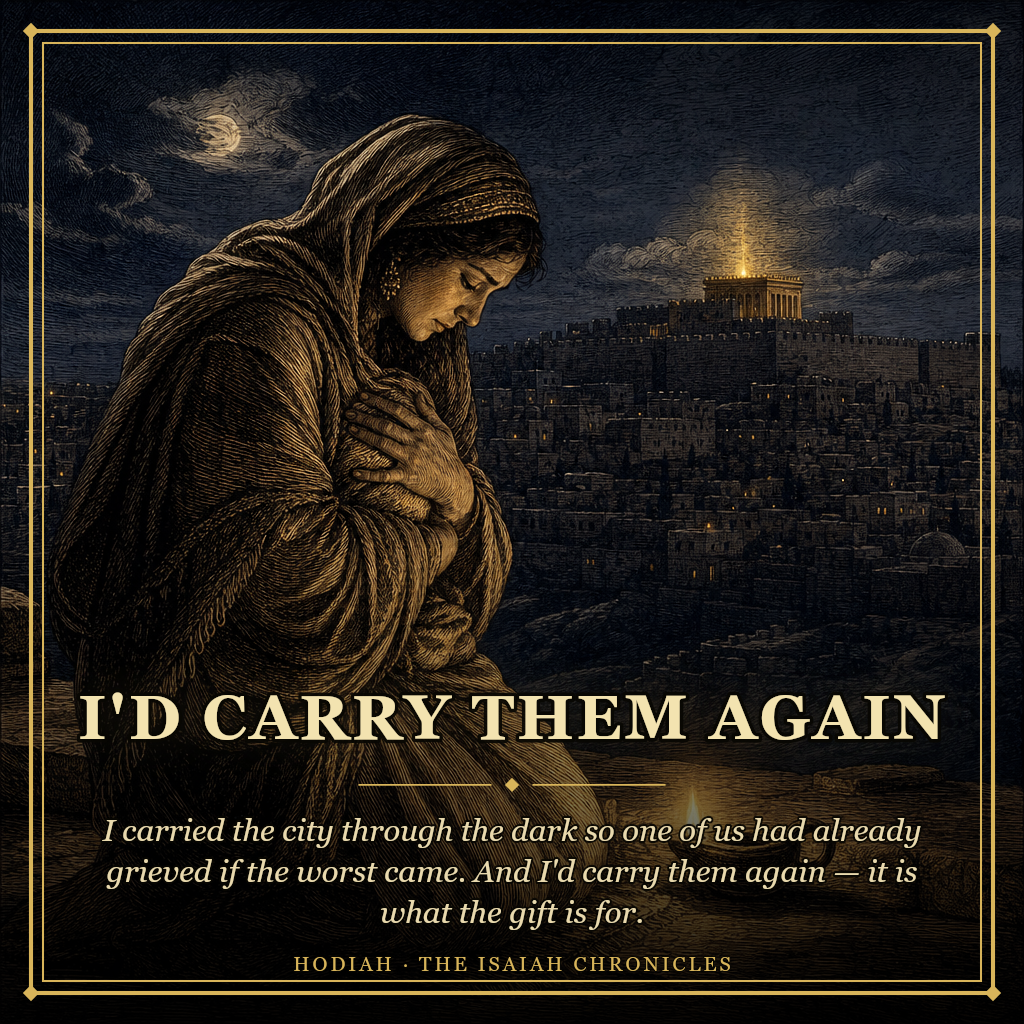
I'd Carry Them Again
H-03MAIN

The names were the prophecy. The children were the proof.

Isaiah's sons were named as living prophecies: Shear-jashub ("a remnant shall return") and Maher-shalal-hash-baz ("swift is the plunder, speedy is the prey"). Every time Hodijah called them to supper, she spoke the word of the LORD over the neighborhood. The family was the sermon.

📜 Isaiah 7:3 · 8:1–4

Read Book 1. The children's names are the first prophecy you meet.

The Hearth and the Temple
H-05MAIN

The fire and the hearth, where the young first learn what it is to be carried.

In ancient Israelite households, the mother was the first teacher of Torah. Long before a son stood in the temple courts, he sat at his mother's fire and heard the word shaped into story. Hodijah's hearth was Isaiah's first pulpit — and the children's first sanctuary.

📜 Isaiah 2:3

Read Book 1. The hearth is where the story begins.

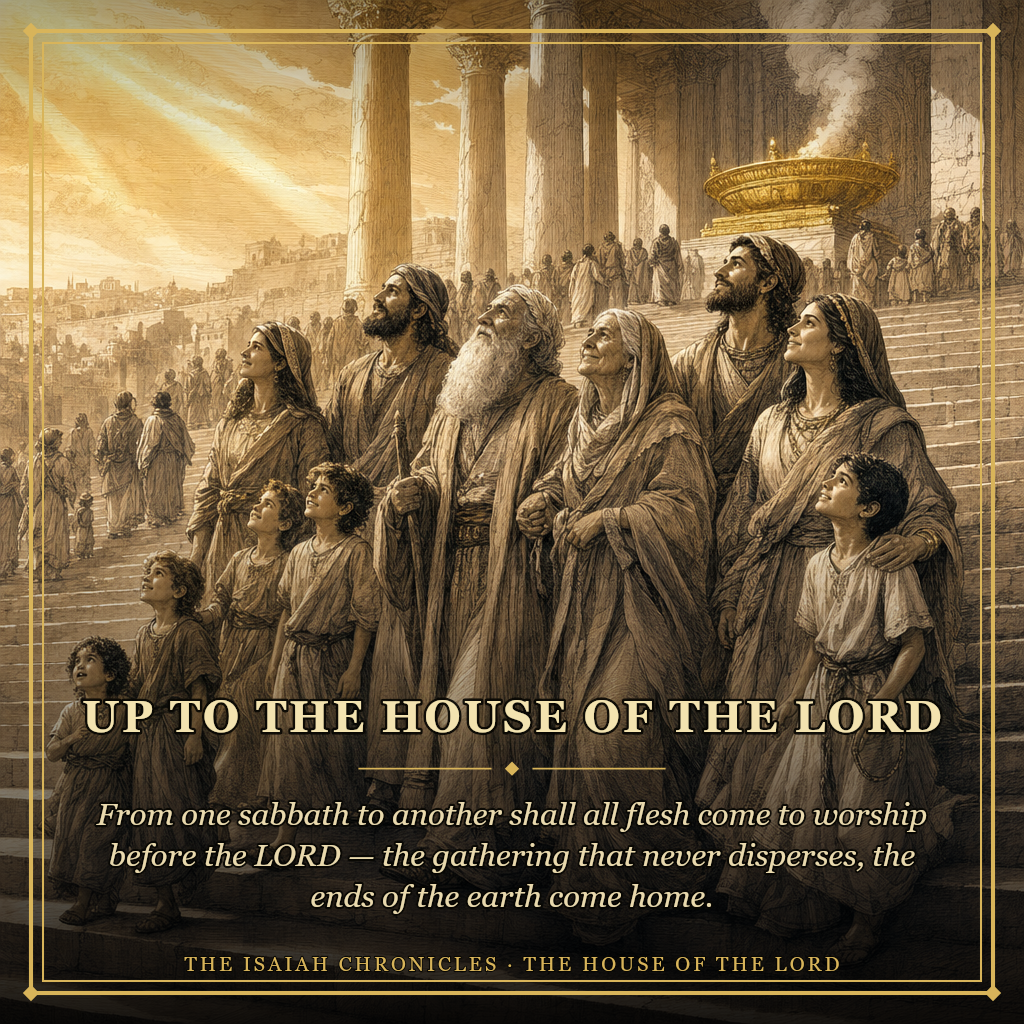
Up to the House of the LORD
H-06FORWARD

The gathering that never disperses. The ends of the earth come home.

Isaiah 2:2–3 describes all nations streaming to the mountain of the LORD's house — not as a distant abstraction but as the destination the whole family is walking toward. In the novel, the annual pilgrimage to Jerusalem is the rhythm that holds the household together across eight books and eight kings.

📜 Isaiah 2:2–3

Read Book 1. The pilgrimage begins on page one.

More cards unlock as you advance the Discovery Guide.

Open my Discovery Guide