
Book One · Isaiah Chronicles

The World of the Isaiah Chronicles

The lands of the Ancient Near East in the 8th century B.C. Tap any pin to read the story behind the place.

What lands did Isaiah walk?

Isaiah of Jerusalem prophesied during the reigns of Uzziah, Jotham, Ahaz, and Hezekiah — roughly 740–700 BC. His world stretched from Jerusalem south to Lachish, north to Samaria, east to Damascus, and far northeast to Nineveh, capital of the Assyrian Empire. Every location on this map is a real place mentioned in the Book of Isaiah or in the corroborating historical record. The Sennacherib Prism (British Museum) records the Assyrian siege of Jerusalem in 701 BC — the same event Isaiah 36–37 describes. The Siloam Inscription (Istanbul Archaeological Museum) records the moment Hezekiah's tunnel workers broke through — the tunnel described in 2 Kings 20:20. Tap any pin to read the story behind the place.

Why did Isaiah say Jerusalem would not fall to Sennacherib?

In 701 BC, the Assyrian king Sennacherib surrounded Jerusalem with an army that had already destroyed 46 Judean cities. Isaiah told Hezekiah the city would not fall — and it didn't. The Sennacherib Prism records the siege and conspicuously never claims the city was taken. Isaiah 37:33–35 records the LORD's promise: "He shall not come into this city, nor shoot an arrow there." The angel of the LORD struck 185,000 Assyrian soldiers in a single night (Isaiah 37:36).

"Therefore thus saith the LORD concerning the king of Assyria, He shall not come into this city, nor shoot an arrow there… For I will defend this city to save it for mine own sake, and for my servant David's sake."

Published · Updated

The World of the Isaiah Chronicles — The Lands of the Ancient Near East in the 8th Century BC, showing the Assyrian Empire advancing on Jerusalem
Sealed — Book 2, the Syro-Ephraimite crisis
Sealed — Book 3, background chapters
Sealed — Book 4, the siege chapters
Capital of Judah · Isaiah's city

Jerusalem

The city Isaiah was born into, prophesied in, and refused to leave. When Sennacherib surrounded it with 185,000 soldiers, Isaiah told Hezekiah it would not fall. It didn't. The Sennacherib Prism records the siege — and conspicuously never claims the city was taken.

📜 Isaiah 37:33–35
Book 1, chapters 1–9
✦ See artifact cards for this era
Sealed

Revealed when Book 2 opens

Sealed

Revealed when Book 3 opens

Sealed

Revealed when Book 4 opens

The Assyrian Empire was the largest military force the ancient world had ever seen. Isaiah watched it advance on his city — and told the king it would not enter.

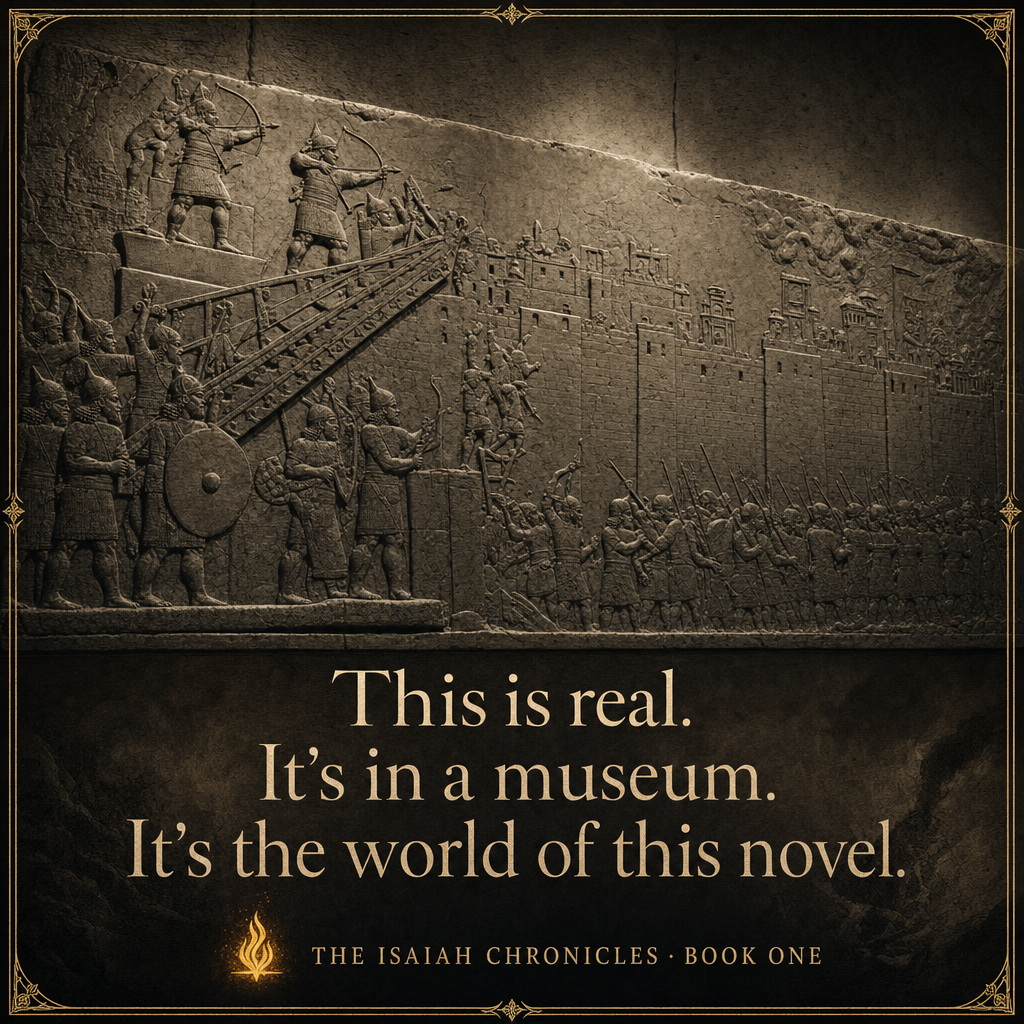
The arrows on this map are not fiction. Sennacherib's own annals record the campaign. The Lachish Reliefs in the British Museum show the siege in stone. The Sennacherib Prism records the siege of Jerusalem — and conspicuously never claims it fell.

The City Gate · Book One

The Pebble Board

"The cleanest game in the ancient world — pebbles, no dice."

At the gate of Jerusalem

In the opening pages of The Year the King Died, a boy sits at the city gate playing Nine Men's Morris — the mill game — against the merchants and soldiers who pass through. He wins, consistently, against men who calculate every move.

They count. He sees. The difference is the whole point of the book.

Why this game

Nine Men's Morris boards have been found carved into the roofing slabs of the temple at Kurna, Egypt — dated to around 1400 BC. The game was ancient when Isaiah was young. No dice, no luck. Pure strategy, pure sight.

It is the recurring ornament of the series: the boy who only sees, against the world that only counts.

How to play

I. Place

Each player places 9 pebbles, one per turn. Form a mill (three in a row) to remove an opponent's pebble.

II. Move

Slide a pebble to an adjacent empty point. Keep forming mills to remove pieces. A pebble in a mill is protected.

III. Fly

When you have only 3 pebbles left, you may jump to any empty point. Win by leaving your opponent with 2 pebbles or no moves.

Play the game from the gate of Jerusalem